Mouth Tape
Customization
Options
Customize mouth tape by route first, then adjust shape, size, material, adhesive, opening design, color, and packaging based on sample feedback.
Route first. Customization second.
Customization Should Not
Start from Random Changes
Many buyers start customization with a simple request: "We want our own shape." "We want this material." "We want a different size." "We want our logo and packaging."
Those requests are normal. But for mouth tape, customization should not start from random changes.
A mouth tape is not just a flat adhesive product. Small changes in shape, size, opening, adhesive behavior, or material structure can change how the patch feels on the mouth.
A larger patch may feel more secure, but also more present. A smaller patch may look easier to wear, but may not feel softer.
A larger opening may increase mouth freedom, but may also increase lip dryness. A different adhesive layout may make two similar materials feel completely different.
That is why our customization process starts with product route selection.
The goal is not to customize everything at once.
The goal is to build a private label mouth tape that fits your target users, packaging direction, and brand promise.
This process reduces the risk of creating a custom product that looks different but does not fit the target user.
Customization Should Start
From Product Route
Before changing material, size, shape, or packaging, a private label buyer should first decide what the product should feel like.
These questions matter because each customization choice affects the final route.
If the buyer wants lower perceived pressure, a larger and stronger full-coverage design may work against that goal.
If the buyer wants an open-center design, opening size and airflow behavior need to be tested.
If the buyer wants beard-friendly removal, adhesive and material route may matter more than shape alone.
Customization Options
Overview
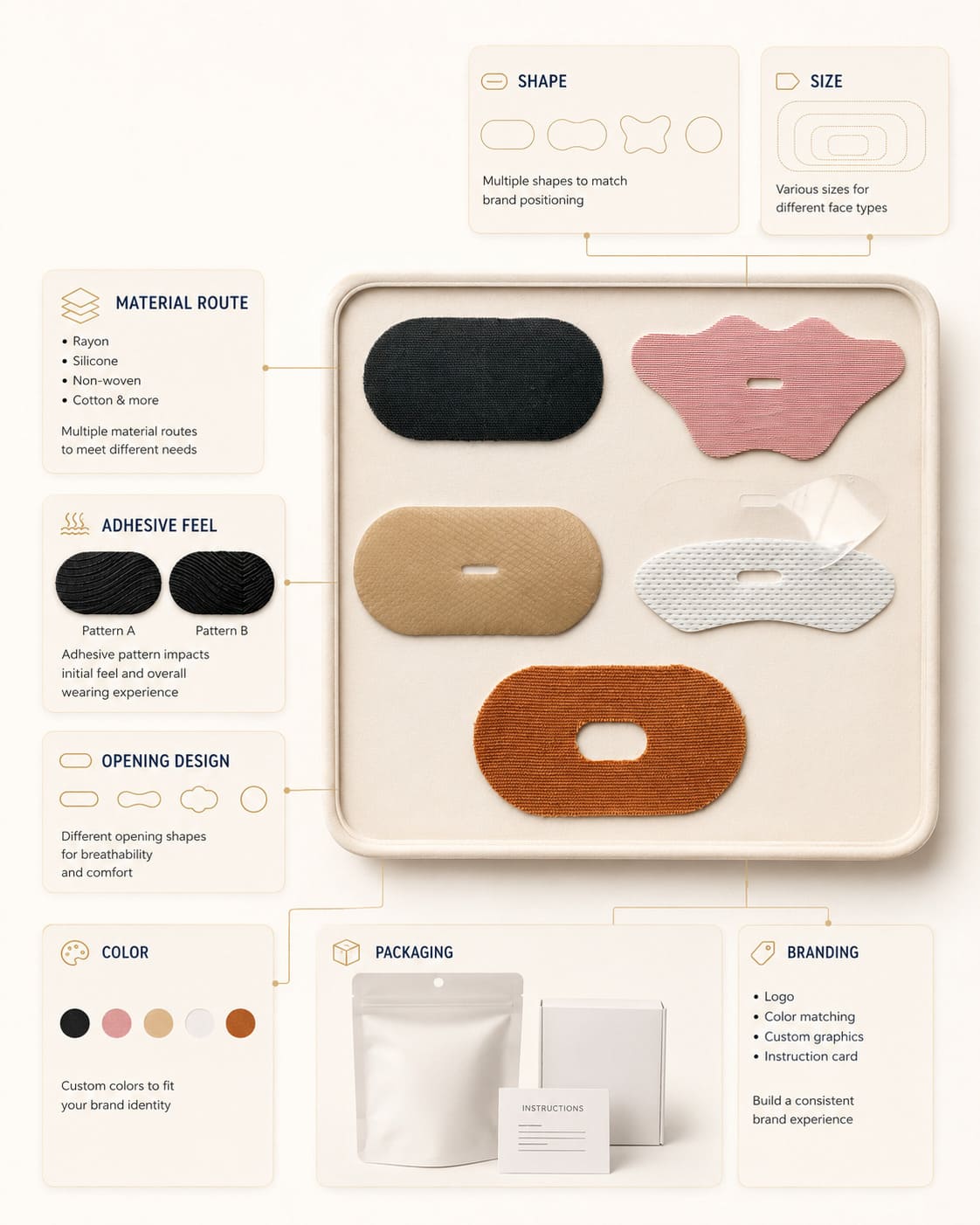
Each customization option should be evaluated by how it changes real use, not only by how it looks on the product sheet.
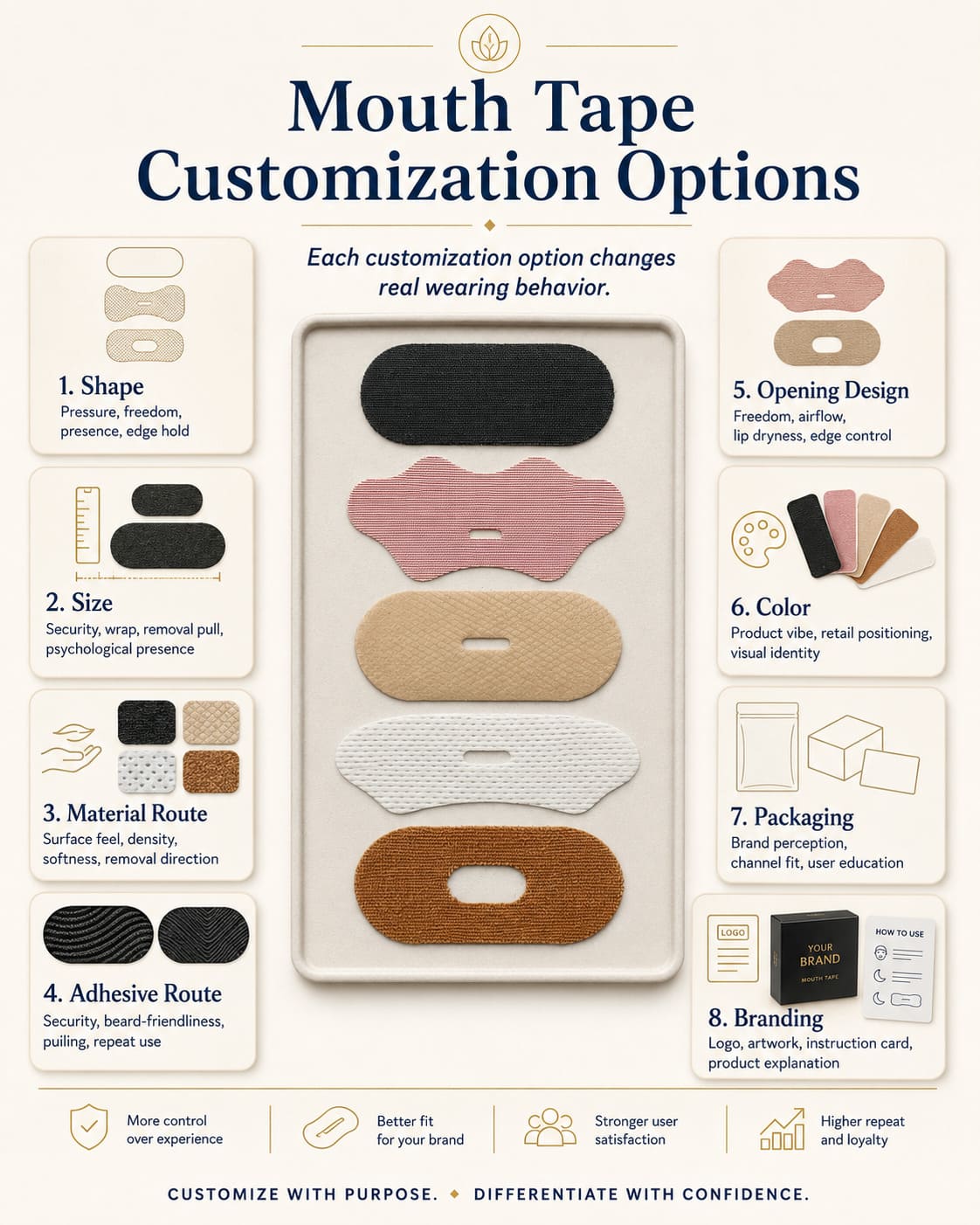
| Customization Area | What Can Be Adjusted | What It Can Change |
|---|---|---|
| Shape | Full coverage, open-center, lip-shaped, dual-zone, compact strip | Pressure, freedom, presence, edge hold |
| Size | Length, width, coverage area | Security, wrap, removal pull, psychological presence |
| Material Route | Cotton, rayon, silicone, non-woven, hydrogel-related options | Surface feel, density, softness, removal direction |
| Adhesive Route | Hold level, removal feel, edge behavior | Security, beard-friendliness, pulling, repeat use |
| Opening Design | Small, medium, large, lip-shaped opening | Freedom, airflow, lip dryness, edge control |
| Color | Black, white, skin-tone, pink, custom color where feasible | Product vibe, retail positioning, visual identity |
| Packaging | Pouch, box, kit, amenity pack | Brand perception, channel fit, user education |
| Branding | Logo, artwork, instruction card, insert | Private label identity and product explanation |
Shape
Customization
Shape is not only an appearance decision. It changes how the patch distributes pressure, how much of the mouth area is covered, and how the user feels the product on the face.
Full Coverage Shape
Full coverage creates a more unified patch format. It can support both low-pressure and strong-hold routes, depending on material, adhesive, thickness, and footprint.
A thin relaxed full-coverage route may feel calm and lower in presence. A larger full-coverage route may feel more secure, more wrapped, and more controlled.
Open-Center Shape
Open-center designs leave part of the lip area exposed. They can increase central mouth freedom, but they also change airflow behavior.
Should be tested for: mouth freedom, edge hold, airflow concentration, lip dryness, edge awareness.
Lip-Shaped Contour
A lip-shaped contour can reduce unnecessary coverage around the mouth. This can lower perceived presence and make the product feel more natural on the face.
The trade-off is that dynamic edge control may be lower than broader shapes during chewing, lip-pursing, or larger movement.
Dual-Zone Structure
A dual-zone design separates the lip-area behavior from the perimeter behavior. This gives more product story and user choice.
Useful when a buyer wants more differentiation than a standard strip.
Compact Strip
A compact strip can look simple and light, but smaller size does not automatically mean lower pressure.
If the material feels dry, stiff, or adhesive-heavy, a compact patch can still feel more present than expected.
Shape customization should be tested on the mouth, not only judged by appearance.
Size
Customization
Size affects both hold and presence. A larger mouth tape usually provides more surface area for adhesion. This can increase security, wrap, and confidence. But it can also increase the feeling of being covered and may create more pulling during removal.
A smaller mouth tape may reduce coverage and look easier to wear. But if the edges are too close to high-movement areas, or if the material feels dry and direct, it may not actually feel softer.
For private label buyers, size should be chosen based on route. If the goal is low pressure, size should not create unnecessary psychological burden. If the goal is strong hold, size may need enough footprint to support security.
- ·Stronger hold
- ·More wrap
- ·Higher security feeling
- ·Less risk of loosening
- ·Presence
- ·Psychological pressure
- ·Removal pull
- ·Lower freedom
- ·Lower visual coverage
- ·Compact format
- ·Lighter product appearance
- ·Weaker edge stability
- ·Stronger localized pulling
- ·Less reassurance
- ·Unexpected presence
If the goal is open-center freedom, the relationship between size, opening, and edge hold must be tested.
Material Route
Options
Material selection should support the product route. It should not be the only decision. The best material choice depends on the product route, not only on the material name.
Cotton Route
May support a more natural, fabric-like, airy direction when the construction is thin and relaxed.
Rayon / Bamboo Silk Route
Often feels smoother, denser, and more silk-like than cotton. Can support smoother fabric feel and more refined surface impression.
May also feel less airy and more controlled if the structure is dense or the footprint is larger.
Silicone Route
May feel more skin-like and hydrated during removal. Can support gentle removal, beard-friendly positioning, and repeat-use acceptance.
May feel thicker or more like a skin patch during wear.
Non-Woven Route
Spunlace non-woven may look lightweight and breathable. But visual lightness does not guarantee soft wear. The actual feel can be dry, firm, or direct depending on adhesive and structure.
Hydrogel-Related Route
May suggest softness and moist skin comfort, but buyers still need to test thickness, stability, residue, and overnight behavior.
The best material choice depends on the product route, not only on the material name.
Compare Material Routes
Adhesive and
Removal Feel Options
Adhesive customization is not only about stronger or weaker glue. It can change edge control, inward pulling, removal comfort, beard-friendliness, residue behavior, repeat-use acceptance, and psychological pressure.
A stronger adhesive feel may help security, but it can also make removal harsher. A gentler removal route may improve repeat use, but may not create the strongest locked-in feeling.
Adhesive layout also matters. Two patches with similar material and size may feel different if the adhesive pattern or stripe direction changes. One may feel relaxed, while another may feel more horizontally gathered and controlled.
For private label buyers, adhesive should be tested as part of the route, not treated as a hidden technical detail.
Helps security, but can make removal harsher
Improves repeat use, but may reduce locked-in feeling
Full Coverage and
Open-Center Options
Full coverage and open-center designs are two important customization directions. Opening customization changes more than appearance. Open-center design should always be sampled before final packaging and bulk order.
Full Coverage
Full coverage provides a more unified patch format. Full coverage is not automatically restrictive. It can be low-pressure or strong-hold depending on the route.
The final feel depends on material, thickness, adhesive, footprint, and edge behavior.
Open-Center
Open-center designs leave part of the lip area exposed. They can support higher mouth freedom and design differentiation.
May increase central freedom but also increase airflow concentration and lip dryness.
May feel more controlled. Less airflow concentration risk.
May feel more natural but may loosen more easily during active mouth movement.
Color and
Appearance Options
Color affects product perception. It should match the route and retail positioning, not only the buyer's brand preference.
Appearance should support the product route. A low-pressure product can use softer visual language. A strong-hold product may use clearer functional language.
A gentle-removal route may use skin-comfort and repeat-use language. Color and appearance should reinforce the route message.
Black
Can feel modern, clean, and premium. May fit wellness, lifestyle, or design-led brands.
White
May feel more simple or functional. Can work for clean sleep accessory positioning.
Skin-Tone
Can feel discreet and skin-patch-like. May be useful when visual subtlety matters.
Pink / Soft Colors
May feel more lifestyle-oriented or gentle, depending on target market and packaging.
Packaging and
Branding Options
Packaging is not only decoration. It helps explain the product route. A low-pressure mouth tape and a strong-hold mouth tape should not use the same message.
Useful for retail, travel, trial, and amenity kits. Usually supported for most routes.
Requires artwork and structure confirmation. Standard private label packaging format.
Good for onboarding, sampling, and brand introduction. Low-barrier entry format.
Compact format for travel and lifestyle positioning. Supports premium accessory branding.
Individual pouch, low-barrier route, instruction card. Suited for hotel or wellness amenity programs.
Multi-product sleep wellness bundle format. Supports premium brand storytelling.
What Usually
Can Be Customized
| Request Type | Status | Notes |
|---|---|---|
| Logo and packaging artwork | Usually supported | Common private label requirement |
| Individual pouch | Usually supported | Useful for retail, travel, trial, and amenity kits |
| Retail box | Usually supported | Requires artwork and structure confirmation |
| Existing shape selection | Usually supported | Best starting point for most buyers |
| Existing material route | Usually supported | Cotton, rayon, silicone, non-woven, and other route options depend on availability |
| Color direction | Usually supported | Needs material and MOQ confirmation |
| Existing full coverage / open-center option | Usually supported | Best to compare through samples first |
| Route-based sample kit | Usually supported | Recommended before final customization |
What Needs
Sample Confirmation
Some requests are possible, but should not be confirmed only on paper. Sample confirmation helps avoid moving into bulk production with a product that looks right but feels wrong.
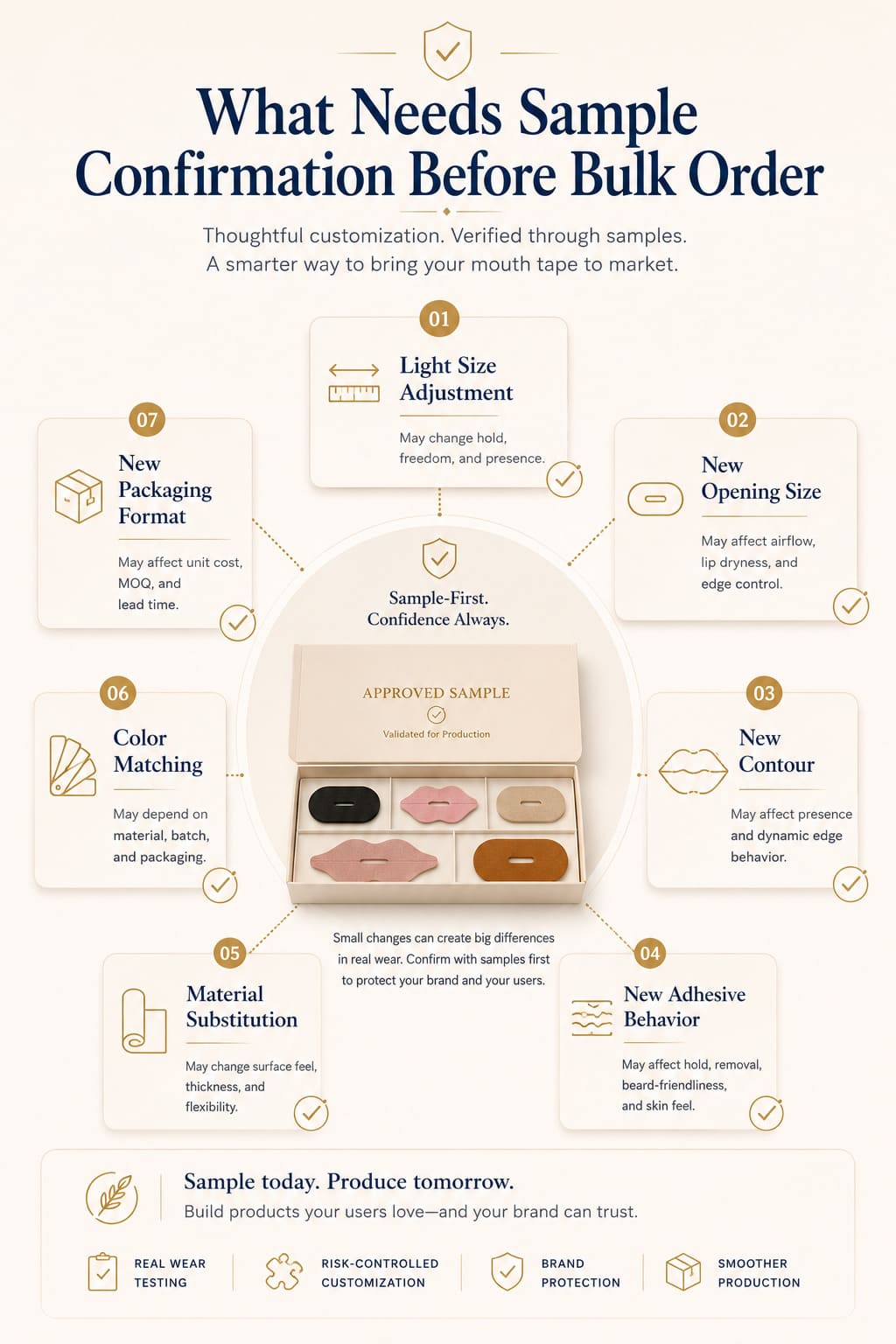
| Request Type | Why Confirmation Is Needed |
|---|---|
| Light size adjustment | May change hold, freedom, and presence |
| New opening size | May affect airflow, lip dryness, and edge control |
| New contour | May affect presence and dynamic edge behavior |
| New adhesive behavior | May affect hold, removal, beard-friendliness, and skin feel |
| Material substitution | May change surface feel, thickness, and flexibility |
| Color matching | May depend on material, batch, and packaging |
| New packaging format | May affect unit cost, MOQ, and lead time |
What Is Not Recommended for Small First Orders
| Request Type | Why Not Recommended Early |
|---|---|
| Completely new structure from zero | Higher development uncertainty and testing requirement |
| Untested material direction | May create unexpected feel or production issues |
| Unverified adhesive system | Can affect removal, hold, and repeat-use acceptance |
| Complex new contour without route validation | May reduce edge stability or increase presence |
| Large customization without sample feedback | Increases risk before buyer understands the route |
| Too many changes at once | Makes it hard to know which change caused the result |
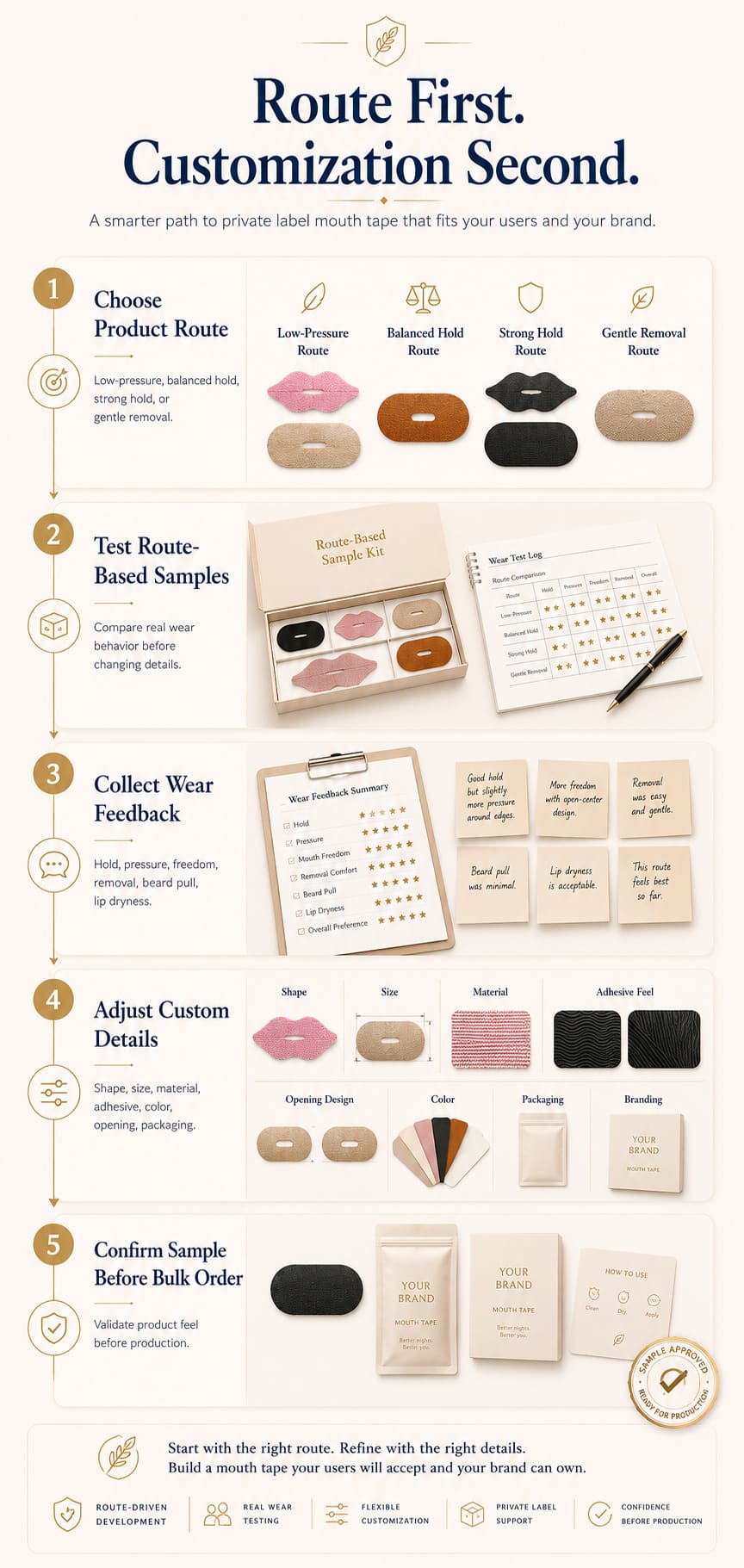
For most buyers, the more practical approach is: existing route → sample test → light customization → packaging confirmation → bulk order.
Route First,
Customization Second
A good customization process should not start with a shape request. It should start with the target user.
Define Target User
- · First-time users
- · Experienced users
- · Users who want stronger hold
- · Users who prefer lower presence
- · Users with beard or removal concerns
- · Hospitality or trial kit users
Choose Product Route
- · Low-pressure route
- · Balanced hold route
- · Strong hold route
- · Gentle removal route
- · Full coverage
- · Open-center
Select Samples & Test Wear
Compare routes before deciding customization. Evaluate:
- · Hold & edge release
- · Freedom & pressure
- · Lip dryness & removal comfort
- · Beard pull & product vibe
Customize, Package & Order
Only after route feedback should the buyer adjust:
- · Shape, size, material, adhesive
- · Color, opening, packaging
- · Finalize packaging to match route
- · Prepare bulk order (MOQ & lead time)
Customization
Decision Matrix
This matrix can help buyers choose which customization path to test first.
| Buyer Goal | Customization Priority |
|---|---|
| Lower pressure | Thinner route, softer edge behavior, lower presence contour |
| Stronger hold | Larger coverage, stronger perimeter, controlled adhesive logic |
| More mouth freedom | Open-center or lip-shaped opening |
| Lower lip dryness risk | Consider full coverage or test opening size carefully |
| Gentle removal | Silicone route or softer adhesive release |
| Beard-friendly use | Removal profile and adhesive behavior |
| Premium look | Color, contour, packaging, surface feel |
| Hospitality kit | Individual pouch, low-barrier route, instruction card |
| Functional sleep line | Secure hold route, clearer application message |
| Broad retail fit | Balanced hold route and route-based sample comparison |
Pre-Customization
Checklist
This checklist helps buyers avoid changing details before understanding the product route. Before requesting customization, confirm the following.
- ·What is the target user group?
- ·Is the product comfort-led, security-led, or balanced?
- ·Should it feel wellness-oriented or more functional?
- ·Low-pressure or strong hold?
- ·Full coverage or open-center?
- ·Gentle removal or stronger grip?
- ·Cotton, rayon, silicone, or another material route?
- ·Desired hold level?
- ·Acceptable presence?
- ·Required mouth freedom?
- ·Removal comfort requirement?
- ·Beard-friendliness concerns?
- ·Individual pouch?
- ·Retail box?
- ·Trial kit or amenity kit?
- ·Is a route-based sample kit needed?
- ·Which routes should be compared?
How Customization Connects
to Private Label Production
Customization is not separate from production. Every customization choice affects sample approval, packaging design, material preparation, unit cost, MOQ, lead time, user acceptance, and repeatability in bulk production.
A simple logo and packaging project may move faster. A new shape, new opening, or new adhesive feel requires more sample confirmation.
That is why the route-first process is important. It helps buyers decide which customization choices are worth making and which should wait until the route is validated.
Request Custom Mouth
Tape Samples
If you are planning a private label mouth tape project, we can help you compare route options before finalizing customization.
Not sure what to customize first? Start with a route-based sample kit.
Frequently
Asked Questions
Common questions from private label and OEM buyers about mouth tape customization options.
Ask a Custom Question