Mouth Tape
Products
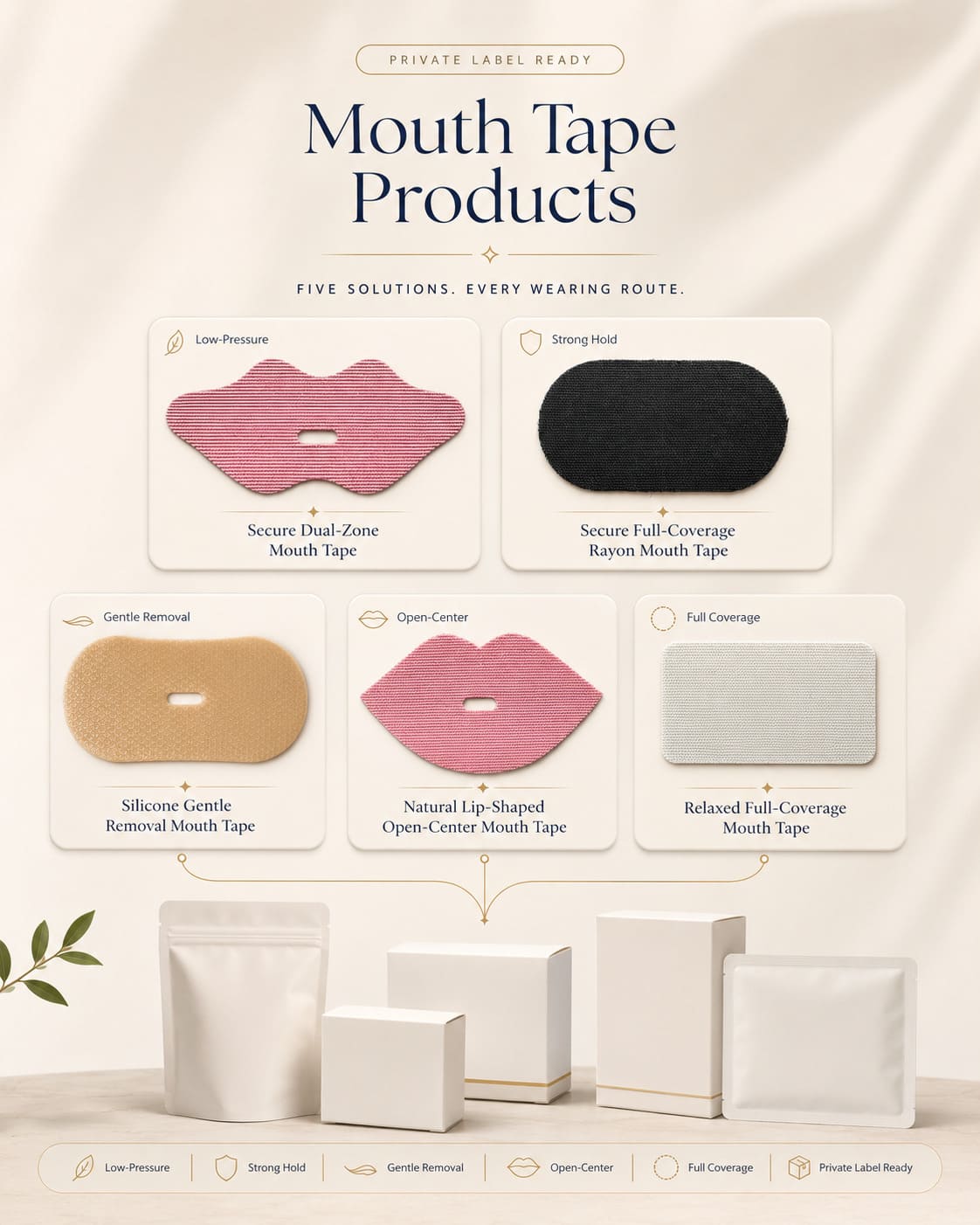
Private label sleep mouth tape products organized by real wear routes -- low-pressure, balanced hold, strong hold, gentle removal, full coverage, and open-center options.
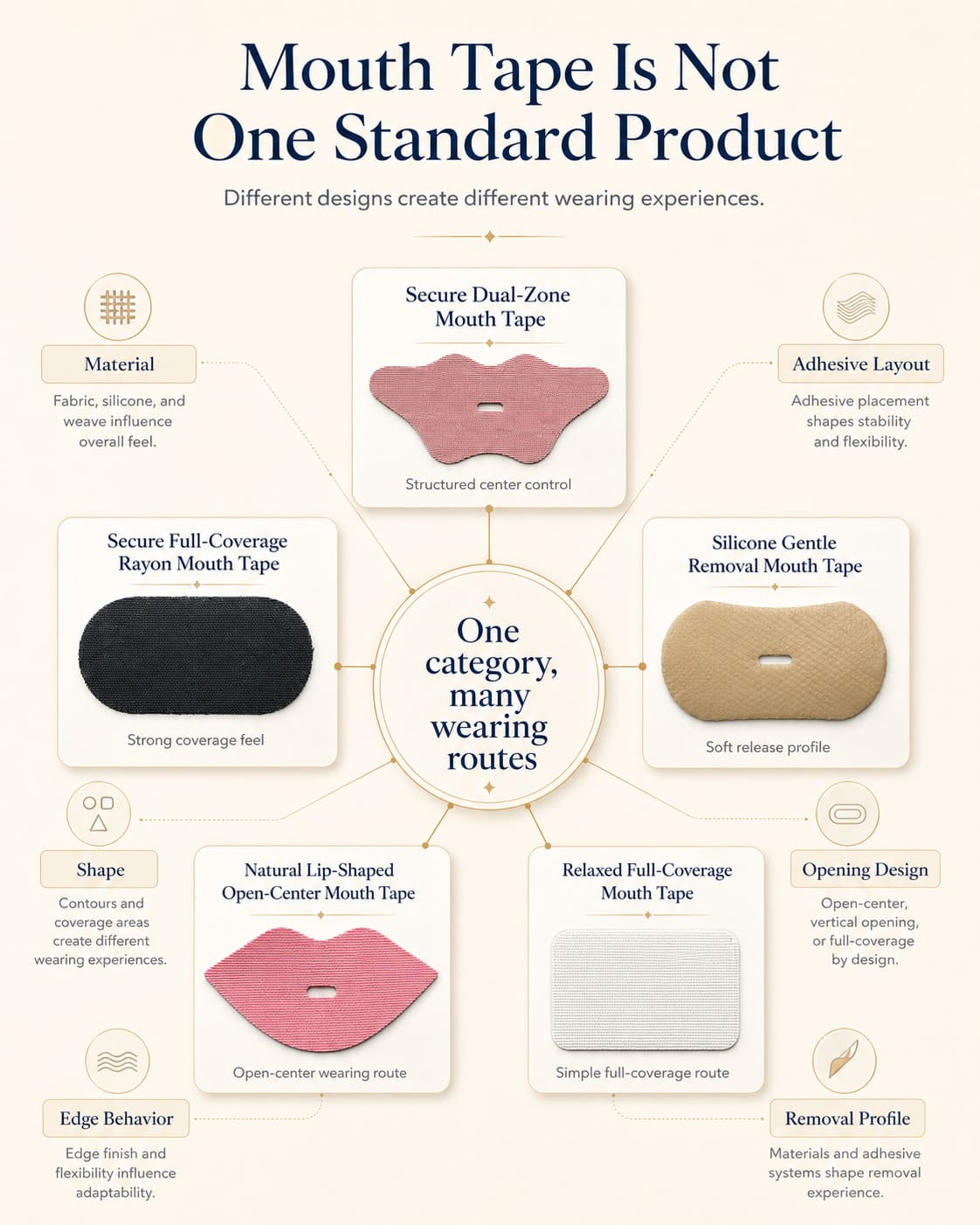
Mouth tape looks simple from the outside. But for private label buyers, it should not be treated as one standard product. Different mouth tape designs can feel very different in real use. That is why our mouth tape product system is organized by real wear routes, not only by material names.
Mouth Tape Is Not
One Standard Product
Many buyers first ask: "What material is the mouth tape?" That is a useful question, but it is not enough.
A mouth tape product is shaped by the full combination of material, adhesive, adhesive layout, shape, size, opening design, edge behavior, removal profile, packaging message, and end-user comfort tolerance.
Two products with similar materials can still feel different. A cotton route can feel relaxed, but another cotton route can feel more gathered and controlled if the adhesive layout changes. A rayon route can feel smoother and more refined, but it can also feel denser and more present. A smaller patch can look lighter, but it does not automatically feel softer.
"Which mouth tape route fits my target users and brand positioning?"
For B2B buyers, the right mouth tape product depends on:
Main Mouth Tape
Product Routes
We organize mouth tape products into four main product routes. These are not consumer-style shopping categories. They are B2B selection routes designed to help private label buyers choose the right product direction before packaging and bulk order.
Each route can include different shapes, materials, and packaging formats. This is why route selection should happen before final packaging or bulk production.
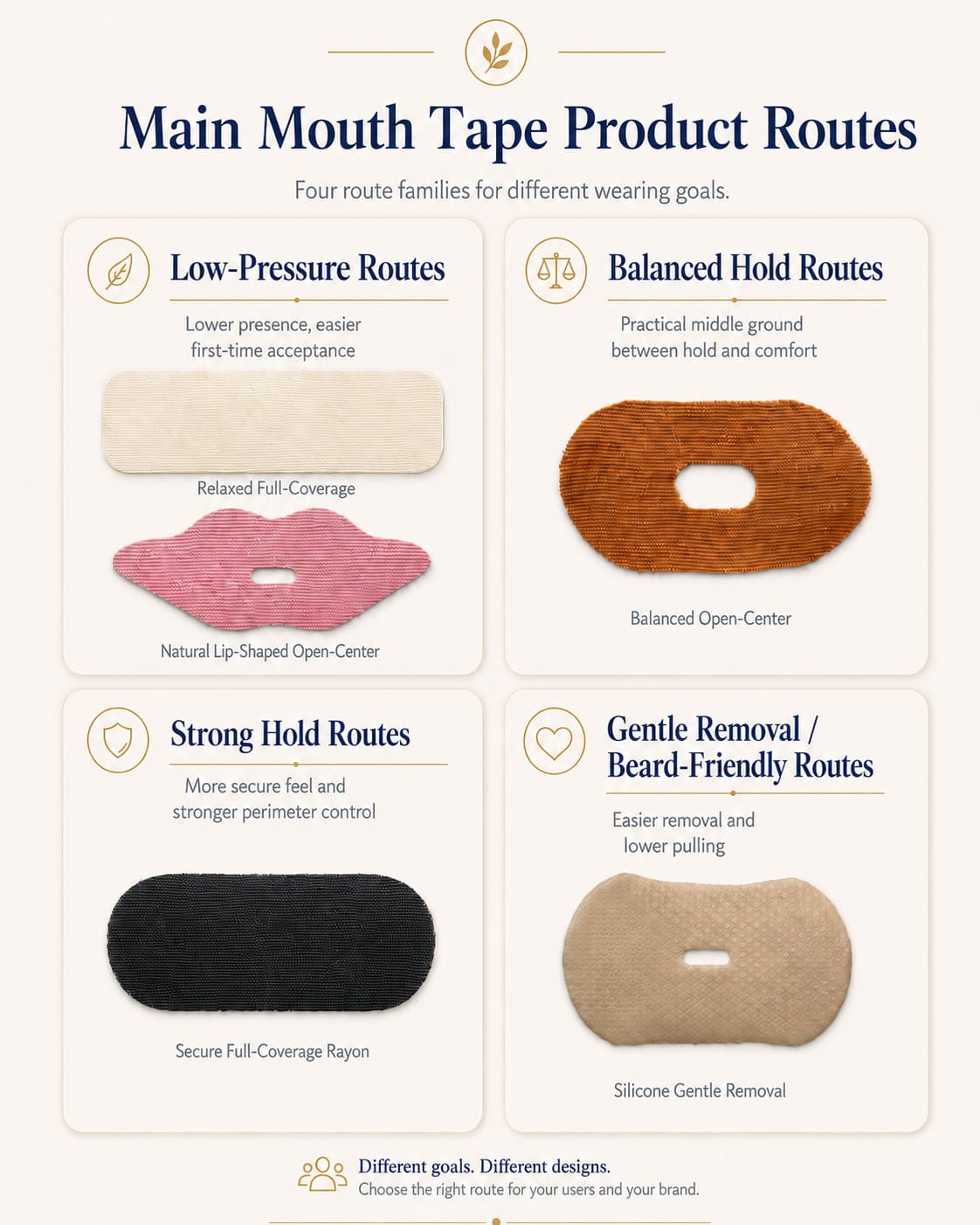
Low-Pressure Routes
Lower perceived pressure, lower presence, easier first-time acceptance. Best for sleep & wellness brands, starter kits, hospitality trial products.
View Low-Pressure RoutesBalanced Hold Routes
Middle ground between hold, freedom, and user acceptance. Best for broad-market programs, first private label launch, distributor samples.
View Balanced Hold RoutesStrong Hold Routes
More secure feel, stronger perimeter control, more locked-in experience. Best for security-first users, functional sleep products, secure-hold positioning.
View Strong Hold RoutesGentle Removal / Beard-Friendly
Easier removal, lower pulling, repeat-use comfort. Best for sensitive users, beard users, premium wellness positioning.
View Gentle Removal Routes
Explore Each Route
in Detail
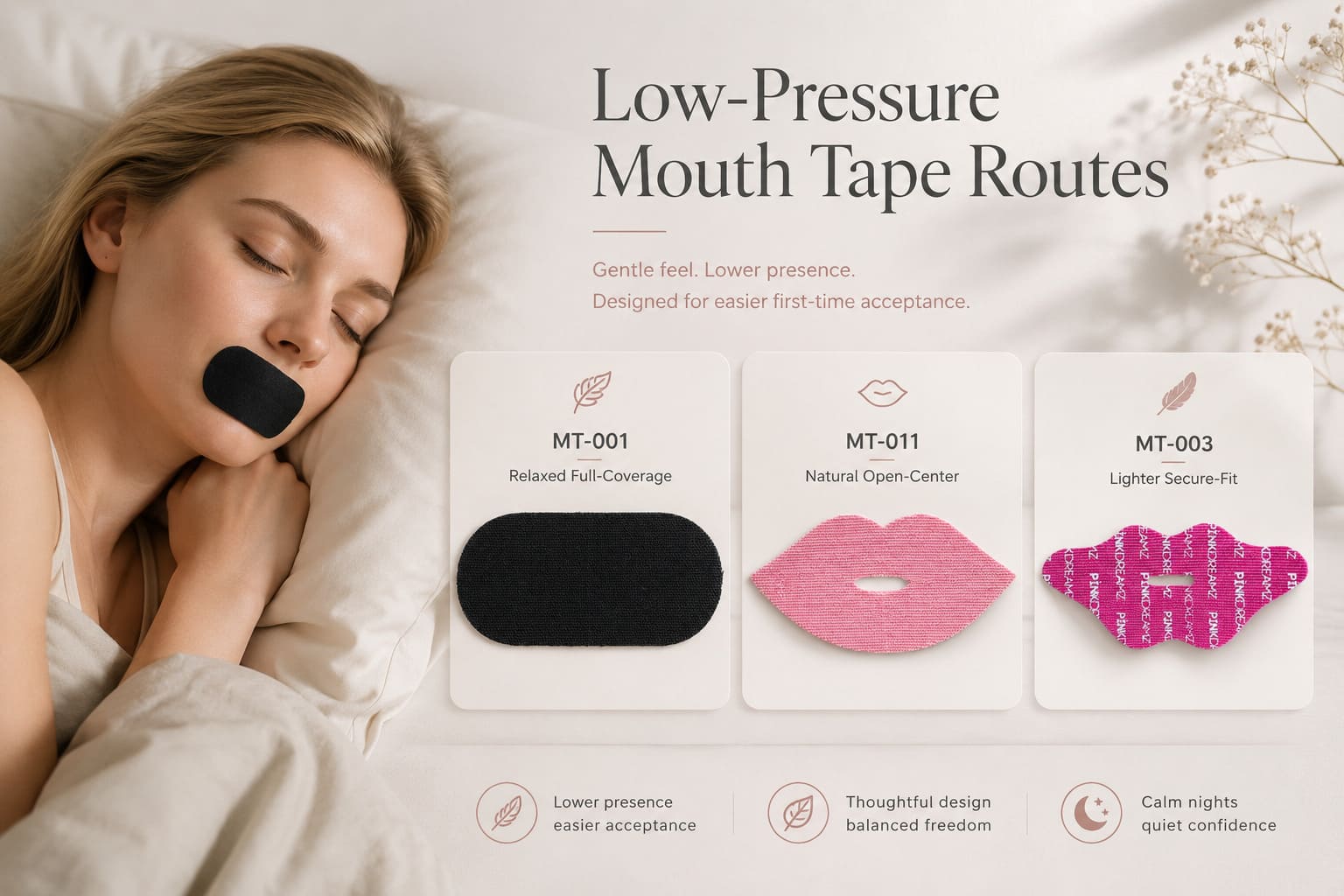
Low-Pressure Routes
Lower perceived pressure, lower presence, easier first-time acceptance.
Explore Route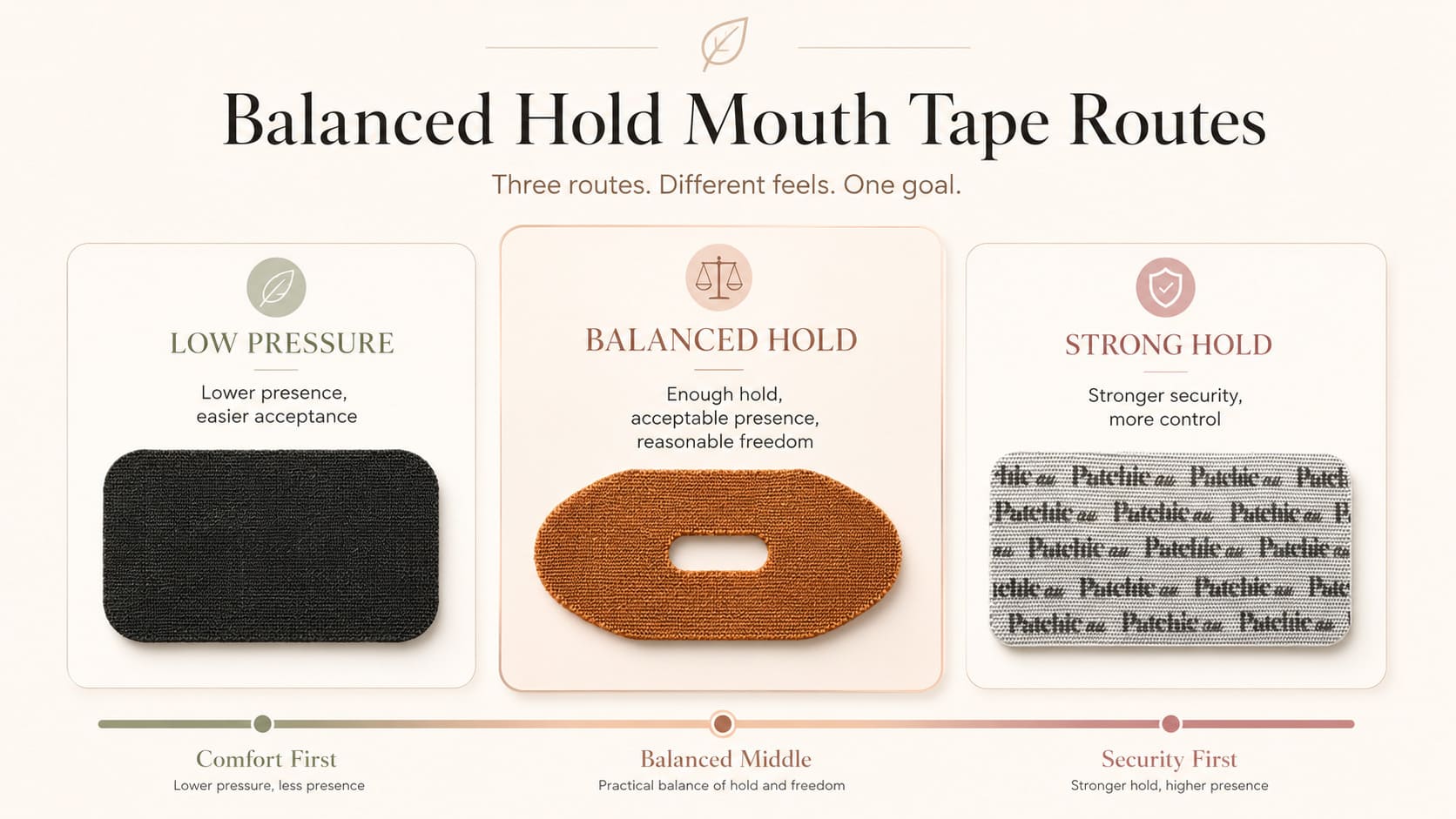
Balanced Hold Routes
Middle ground between hold, freedom, and user acceptance.
Explore Route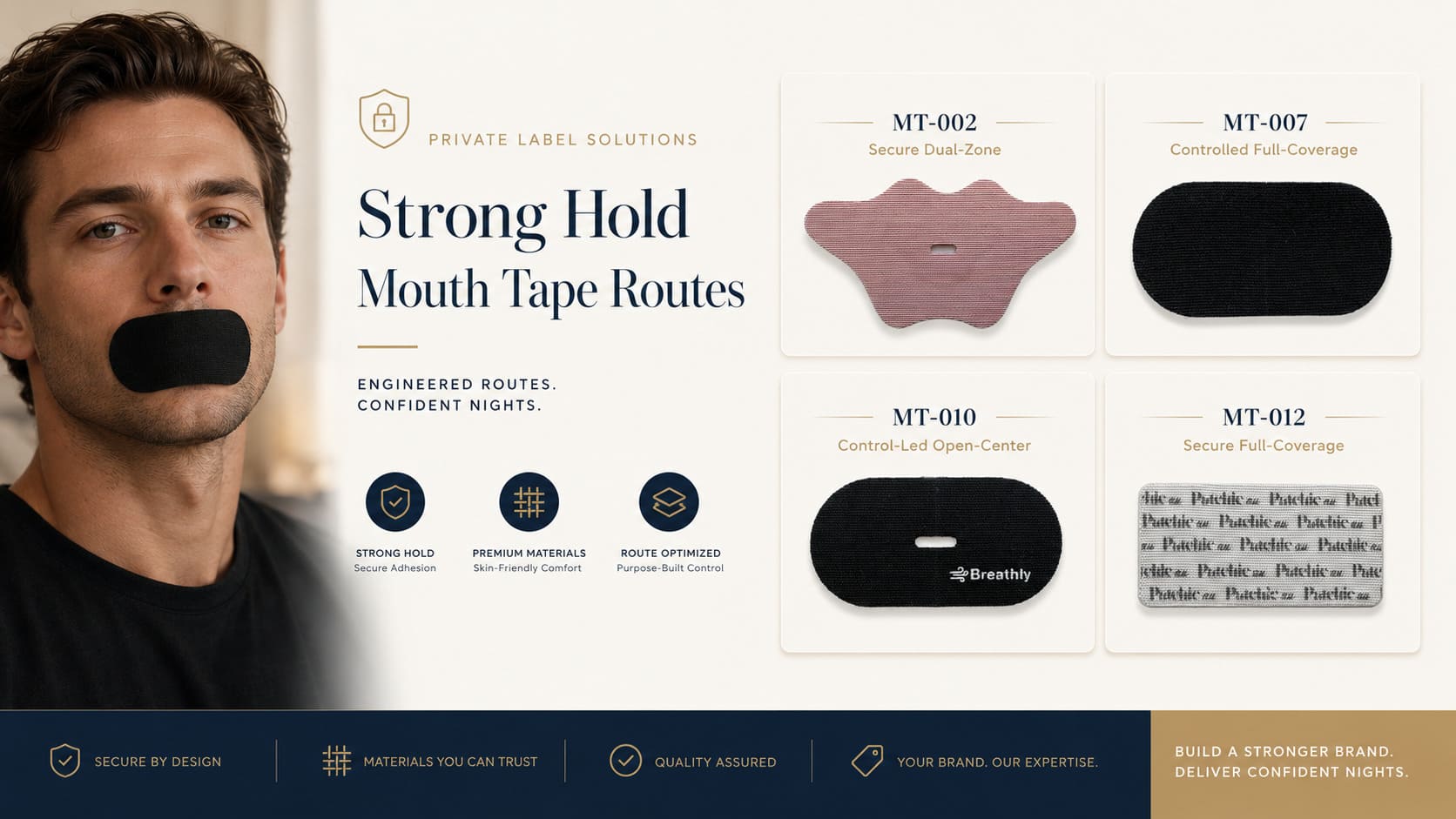
Strong Hold Routes
More secure feel, stronger perimeter control, more locked-in experience.
Explore Route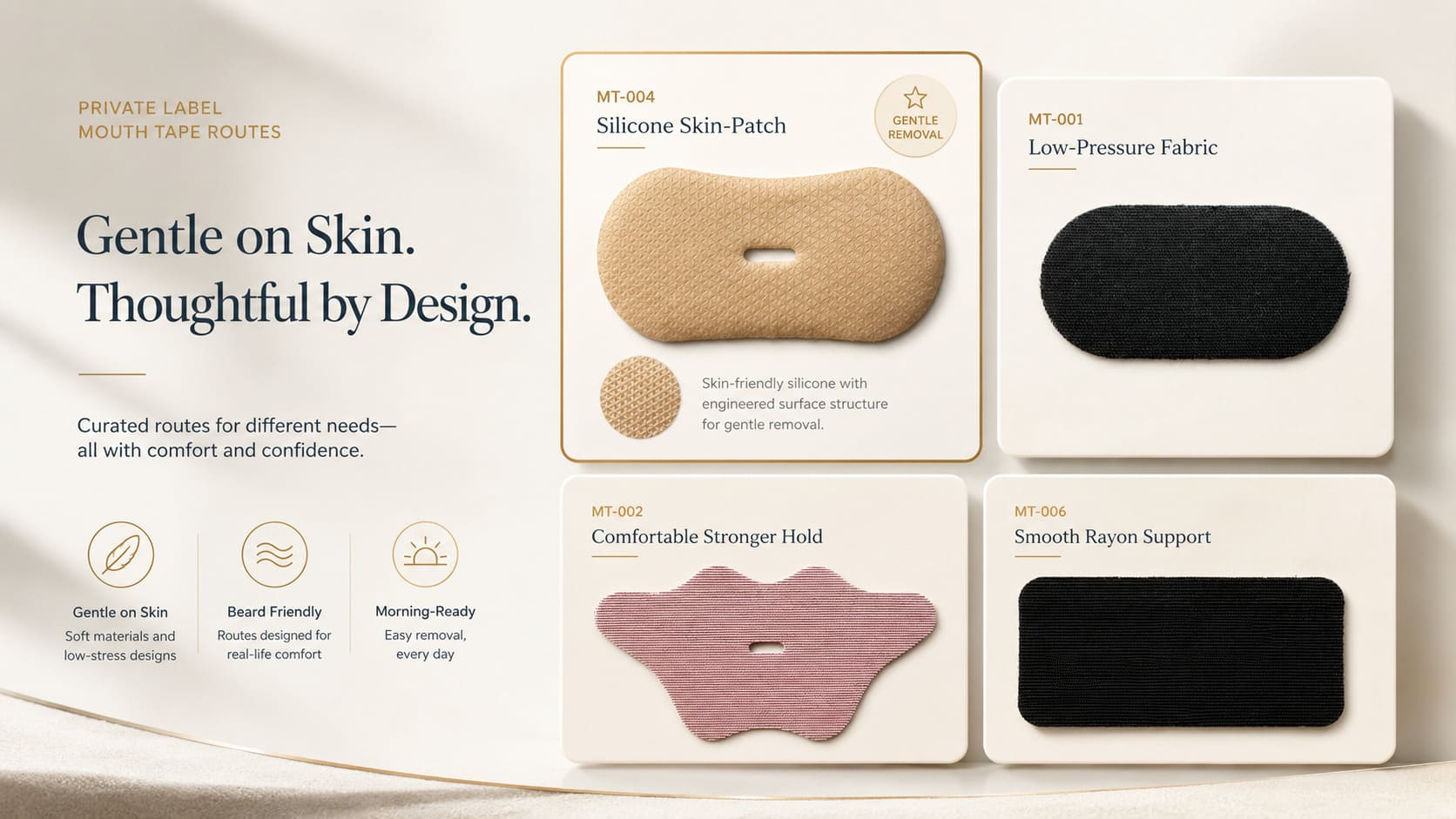
Gentle Removal / Beard-Friendly
Easier removal, lower pulling, repeat-use comfort.
Explore RouteLow-Pressure Mouth Tape Routes
Low-pressure routes are designed for easier acceptance. They are useful when the product should feel softer, less intimidating, and less control-heavy. This does not mean the patch is weak. It means the patch should feel easier on the face while still staying secure enough for the intended product experience.
Low-pressure routes may come from: thinner construction, softer edge behavior, lower perceived presence, less inward pulling, a more natural contour, or reduced unnecessary coverage around the mouth.
Best for:
- First-time users
- Comfort-first sleep products
- Sleep & wellness retail
- Hospitality or amenity kits
- Premium private label programs
- Users sensitive to restriction
Low-pressure routes may not create the strongest locked-in feeling. Some designs may allow more dynamic edge release during larger mouth movement.
Balanced Hold Mouth Tape Routes
Balanced hold routes are designed for buyers who need a practical middle ground. Not every product line should start with the softest route or the strongest route. Some buyers need enough hold, acceptable presence, and reasonable freedom before they know which direction their market prefers.
Balanced hold routes may be useful when the buyer is launching a first private label line, building a broad-market product, preparing a distributor sample kit, unsure whether users prefer comfort or control, or testing multiple route options before committing.
Best for:
- General wellness brands
- Broad-fit private label programs
- First SKU development
- Sample kits
- Distributor or wholesale evaluation
Balanced routes may not have the strongest single marketing story. Their value is practical fit, not extreme comfort or extreme control.
Strong Hold Mouth Tape Routes
Strong hold routes are designed for buyers who want a more secure feel. Some users want to feel that the patch will stay in place. They may accept higher presence and lower mouth freedom in exchange for more confidence.
Strong hold can come from: larger coverage, stronger perimeter engagement, smaller opening size, firmer edge control, adhesive layout, more wrap around the mouth, or less edge release during movement.
Best for:
- Security-first users
- Functional sleep product lines
- Users worried about loosening
- Experienced mouth tape users
- Brands with secure-hold messaging
Stronger hold usually brings more presence, lower freedom, and sometimes more pulling during removal. It should not be positioned as the easiest route for every first-time user.
Gentle Removal / Beard-Friendly Routes
Gentle removal routes prioritize how the patch comes off. A mouth tape can hold well and still fail as a repeat-use product if users dislike removing it. Pulling, beard tugging, sticky discomfort, or dry tearing sensation can reduce acceptance.
Gentle removal routes may include: silicone skin-patch direction, softer adhesive release, lower pulling during removal, beard-friendly behavior, or more skin-comfort focused product story.
Best for:
- Beard-friendly product lines
- Sensitive-user positioning
- Premium wellness products
- Repeat-use focused buyers
- Users worried about removal
The gentlest removal route may not be the thinnest or lowest-presence route. Silicone routes may remove very comfortably but feel thicker during wear.
Design Options
Mouth tape design options are not only visual choices. They affect freedom, pressure, edge hold, lip dryness, perceived presence, and packaging message.
Design should support the product route. A low-pressure route should avoid unnecessary control. A strong-hold route should have enough structure to feel secure. An open-center route should explain freedom and airflow trade-offs clearly. A gentle-removal route should not be packaged as if it is the thinnest fabric option.
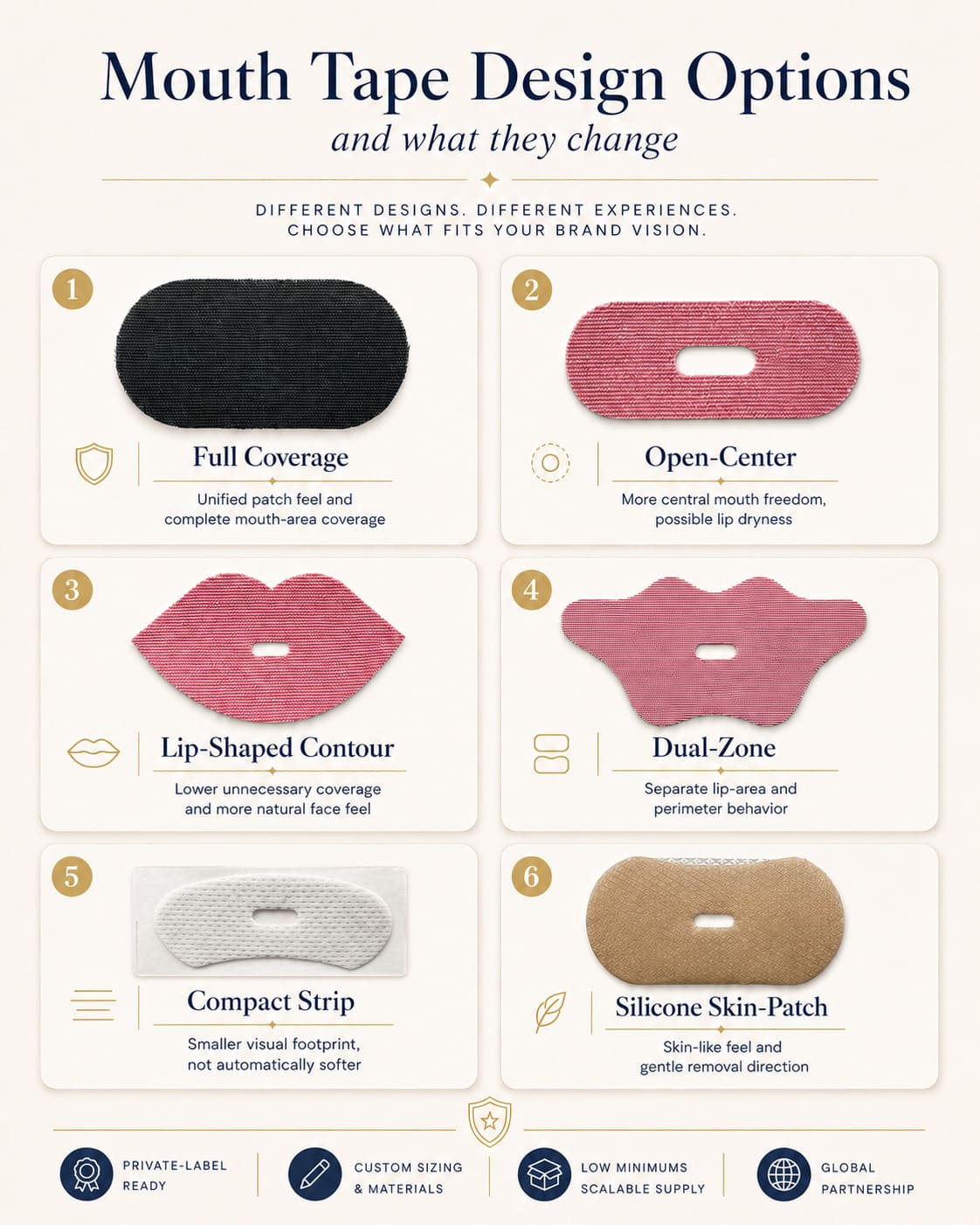
Full Coverage
Unified patch feel, complete mouth-area coverage.
Can be low-pressure or strong-hold depending on material, size, and adhesive.
Open-Center
More central mouth freedom, exposed lip area.
Can increase lip dryness through airflow concentration.
Lip-Shaped Contour
Lower unnecessary coverage, more natural face feel.
Can reduce presence but may loosen more easily during movement.
Dual-Zone
Separate lip-area and perimeter behavior.
Useful for differentiated private label products.
Compact Strip
Smaller format and lighter visual footprint.
Smaller does not automatically mean softer.
Silicone Skin-Patch
Skin-like feel and gentle removal direction.
Can feel thicker or more occlusive during wear.
Material Feel Options
Material matters, but it does not decide the final mouth feel alone. The same material family can behave differently depending on adhesive layout, thickness, contour, size, and opening design.
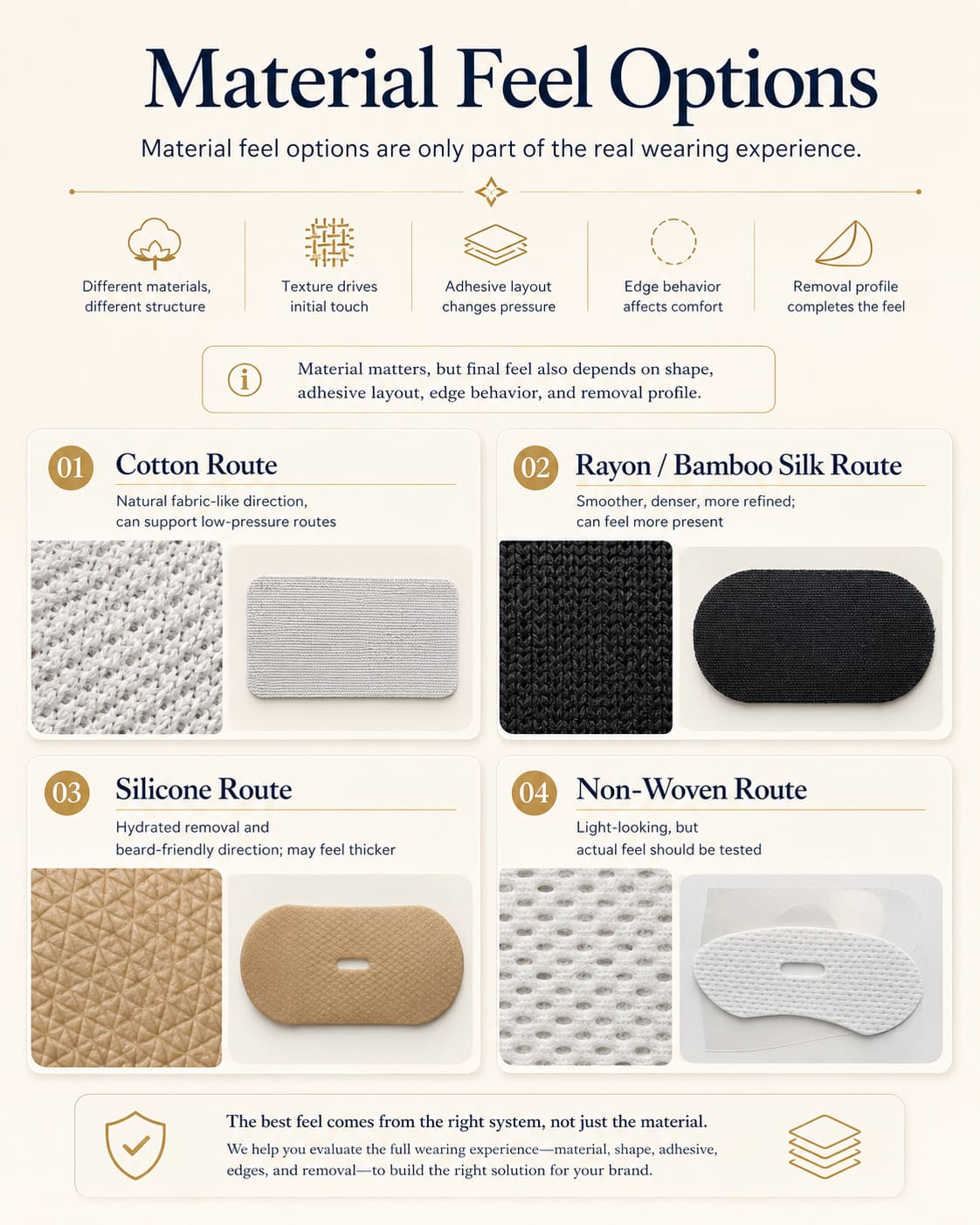
Cotton Route
May support a more natural, fabric-like, airy direction when the construction is thin and relaxed. Useful for low-pressure routes, starter-friendly products, natural fabric feel, sleep & wellness positioning.
Cotton can still feel more controlled if the adhesive layout or coverage changes.
Rayon / Bamboo Silk
Often feels smoother, denser, and more silk-like than cotton. Can support smoother fabric feel, more refined surface impression, stronger full-coverage routes, balanced or secure-hold product positioning.
Rayon can feel less airy, more present, and more controlled if the structure is dense or the footprint is larger.
Silicone Route
May offer more hydrated removal and beard-friendly behavior. Can support gentle-removal routes, sensitive-user positioning, repeat-use comfort, skin-patch style products.
May feel thicker or less fabric-like during wear.
Non-Woven Route
May look light and breathable. Visual lightness does not guarantee soft wear.
Actual feel should be tested before route selection.
Product Route Examples
The following route examples show how mouth tape products can be organized without relying only on material labels. These are route examples, not final public product names. A private label buyer can use them as starting points for sample comparison.
Relaxed Full-Coverage Route
Full coverage can still feel lower-pressure and easier to accept.
Possible buyer fit: Starter-friendly, wellness-led, trial kits
Secure Dual-Zone Route
Stronger perimeter control with optional lip-area behavior.
Possible buyer fit: Differentiated private label products, stronger hold
Silicone Skin-Patch Route
Gentle removal and beard-friendly direction.
Possible buyer fit: Sensitive users, repeat-use products
Natural Open-Center Route
Lower presence through contour and central freedom.
Possible buyer fit: Premium wellness, low-presence positioning
Secure Full-Coverage Route
Stronger wrap, higher security, lower freedom.
Possible buyer fit: Security-first and functional positioning
Compact Strip Contrast Route
Small size does not always mean soft or low-presence.
Possible buyer fit: Education, comparison, utility route
Representative
Product Types
These product type pages show how route directions translate into specific product designs. Use them as starting points for sample comparison and private label planning.
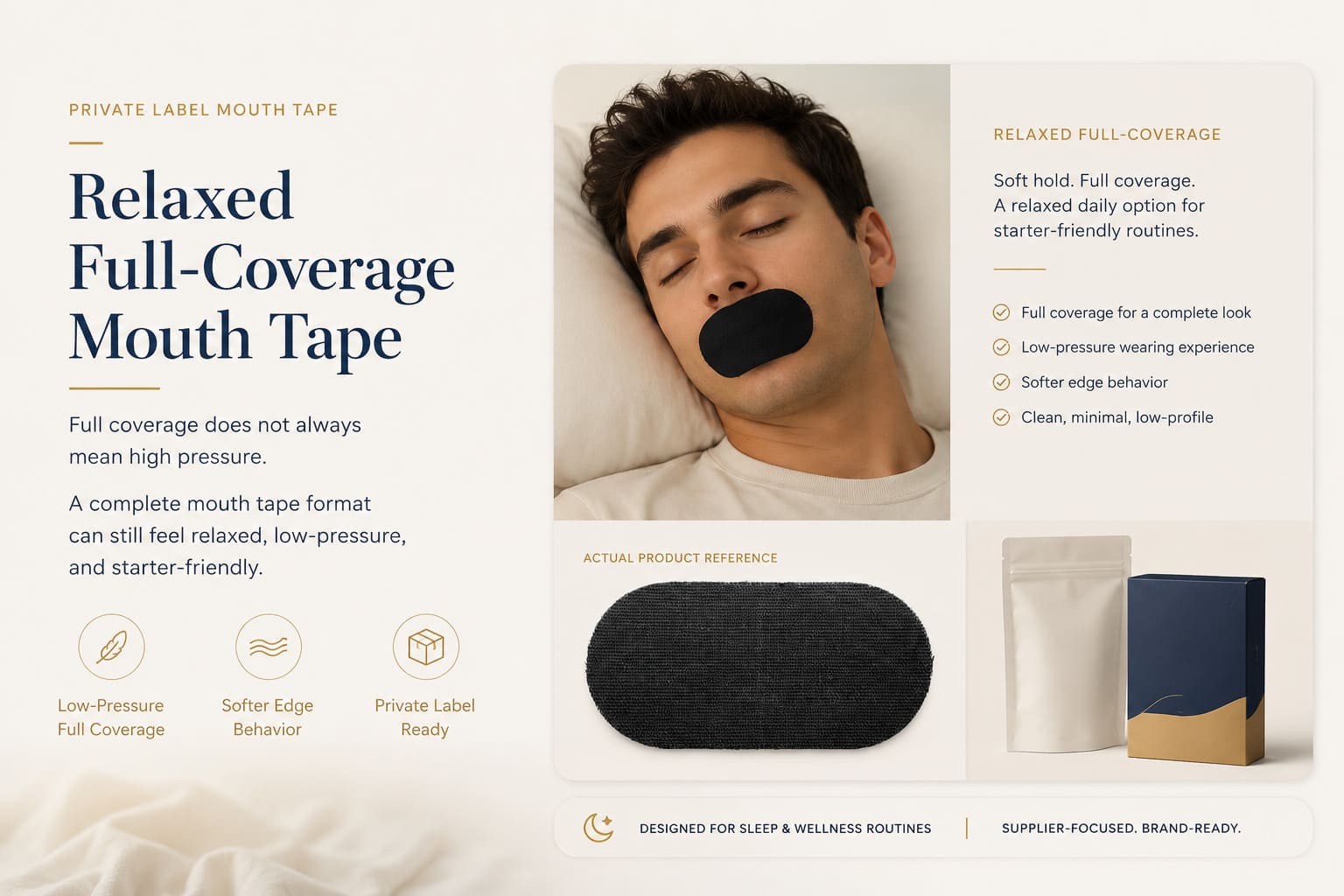
Relaxed Full-Coverage Mouth Tape
Low-pressure full coverage for easier first-time acceptance.
View Product Type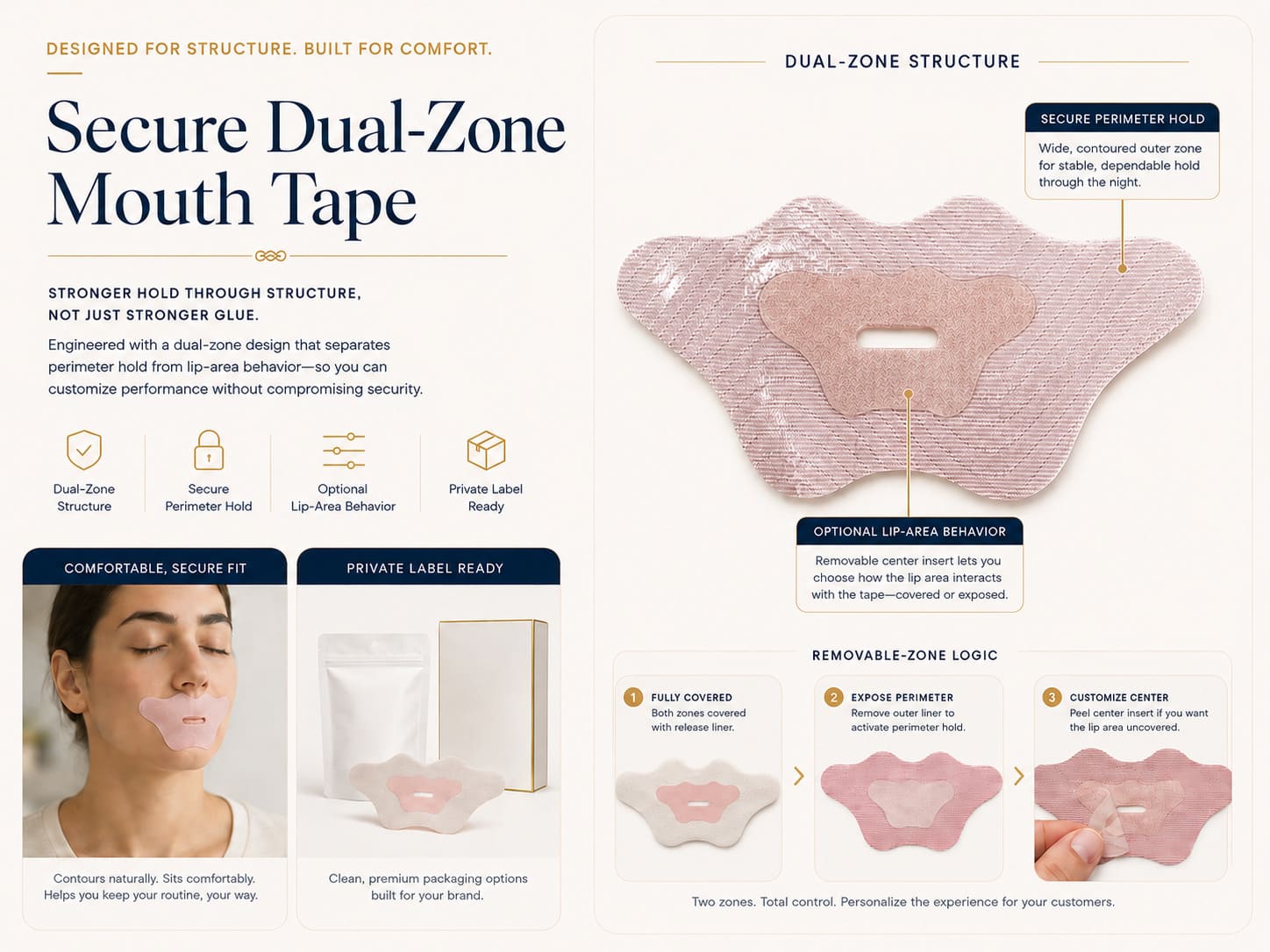
Secure Dual-Zone Mouth Tape
Stronger perimeter hold with optional lip-area behavior.
View Product Type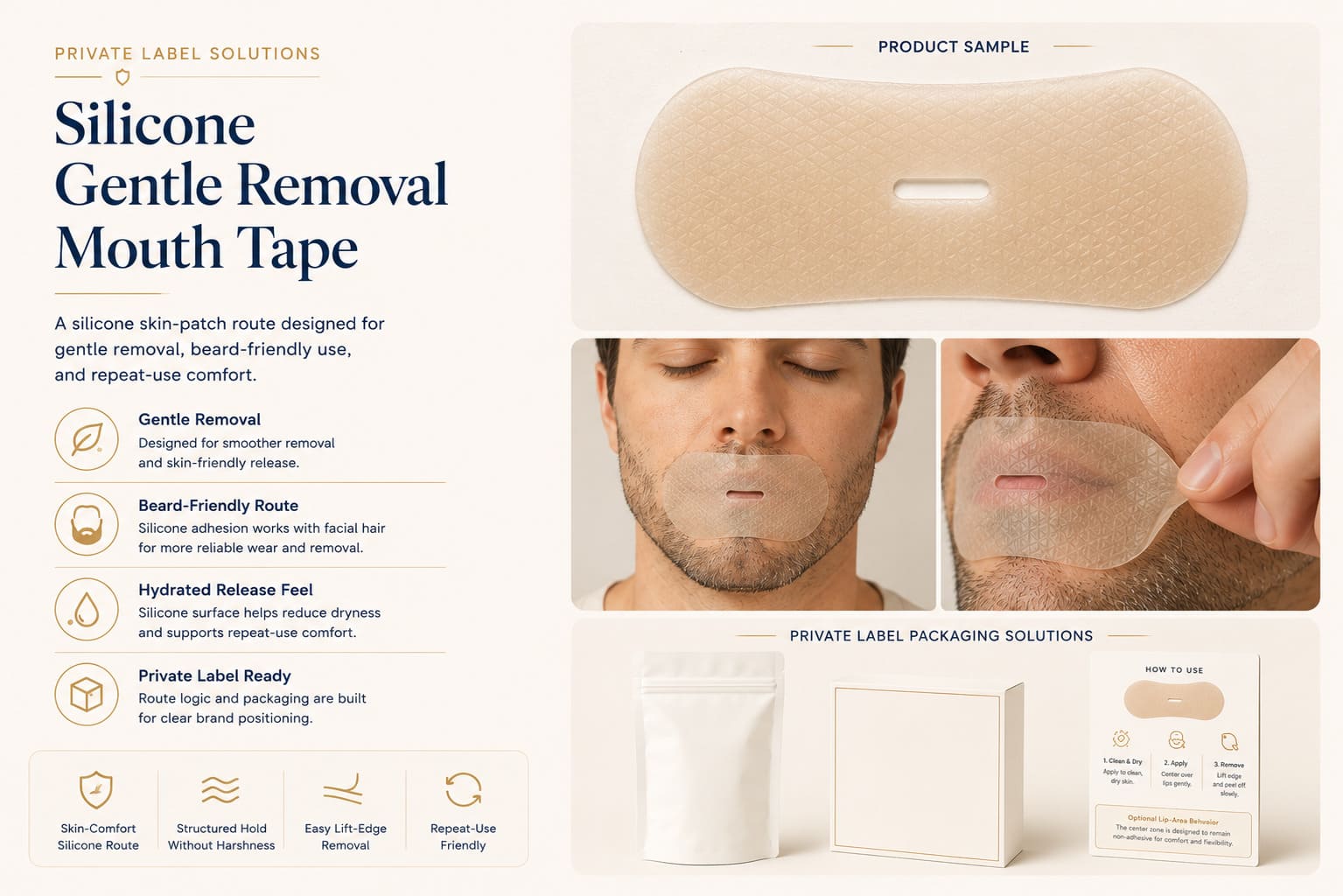
Silicone Gentle Removal Mouth Tape
Silicone skin-patch route for gentle removal and beard-friendly use.
View Product Type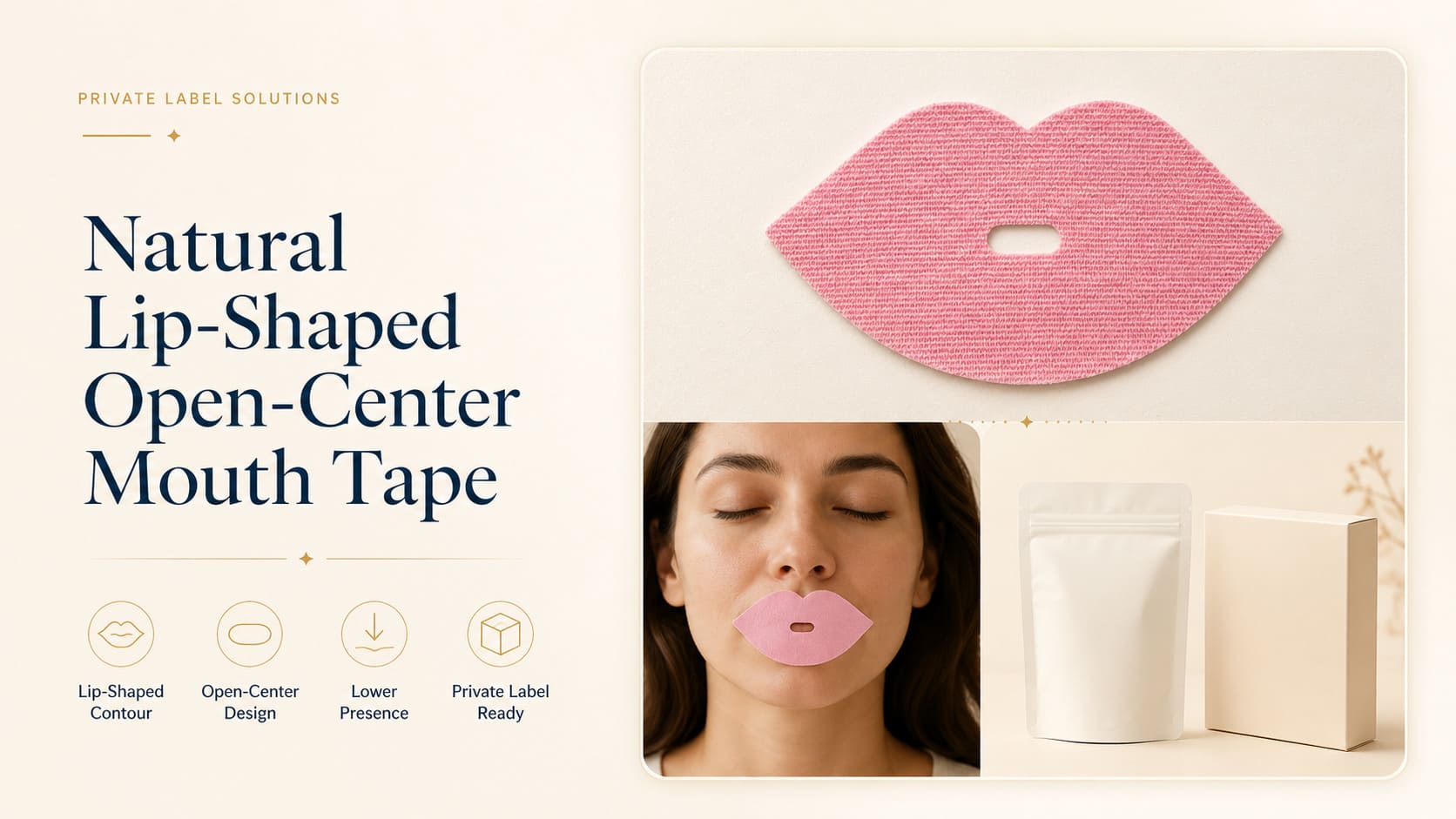
Natural Lip-Shaped Open-Center Mouth Tape
Low-presence open-center route with natural lip-shaped contour.
View Product Type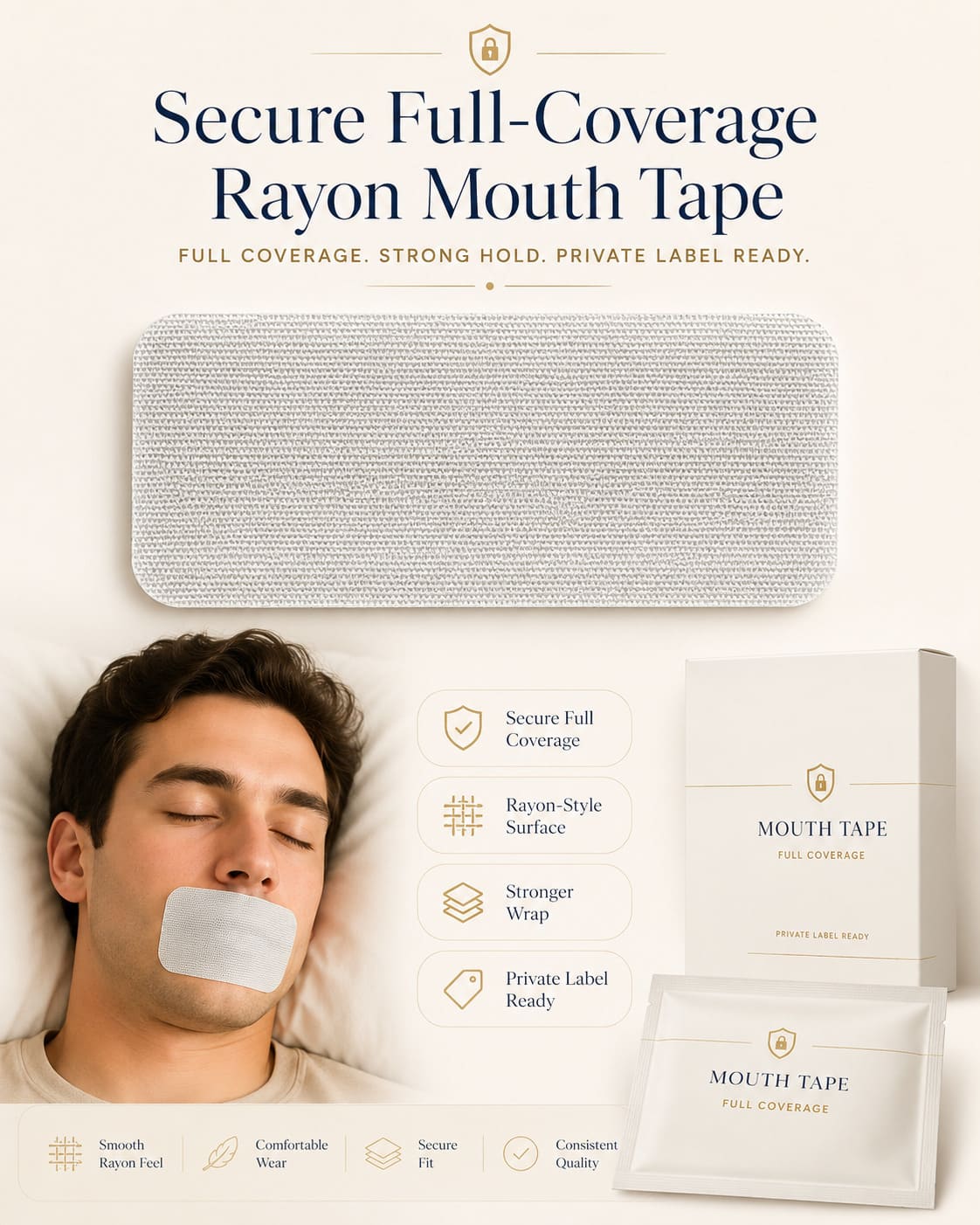
Secure Full-Coverage Rayon Mouth Tape
Strong-hold rayon full coverage for security-first positioning.
View Product TypeNeed a Custom Product Type?
Our OEM team works from your brief to develop a product route that fits your target users and brand positioning.
Product Routes vs
Design Options
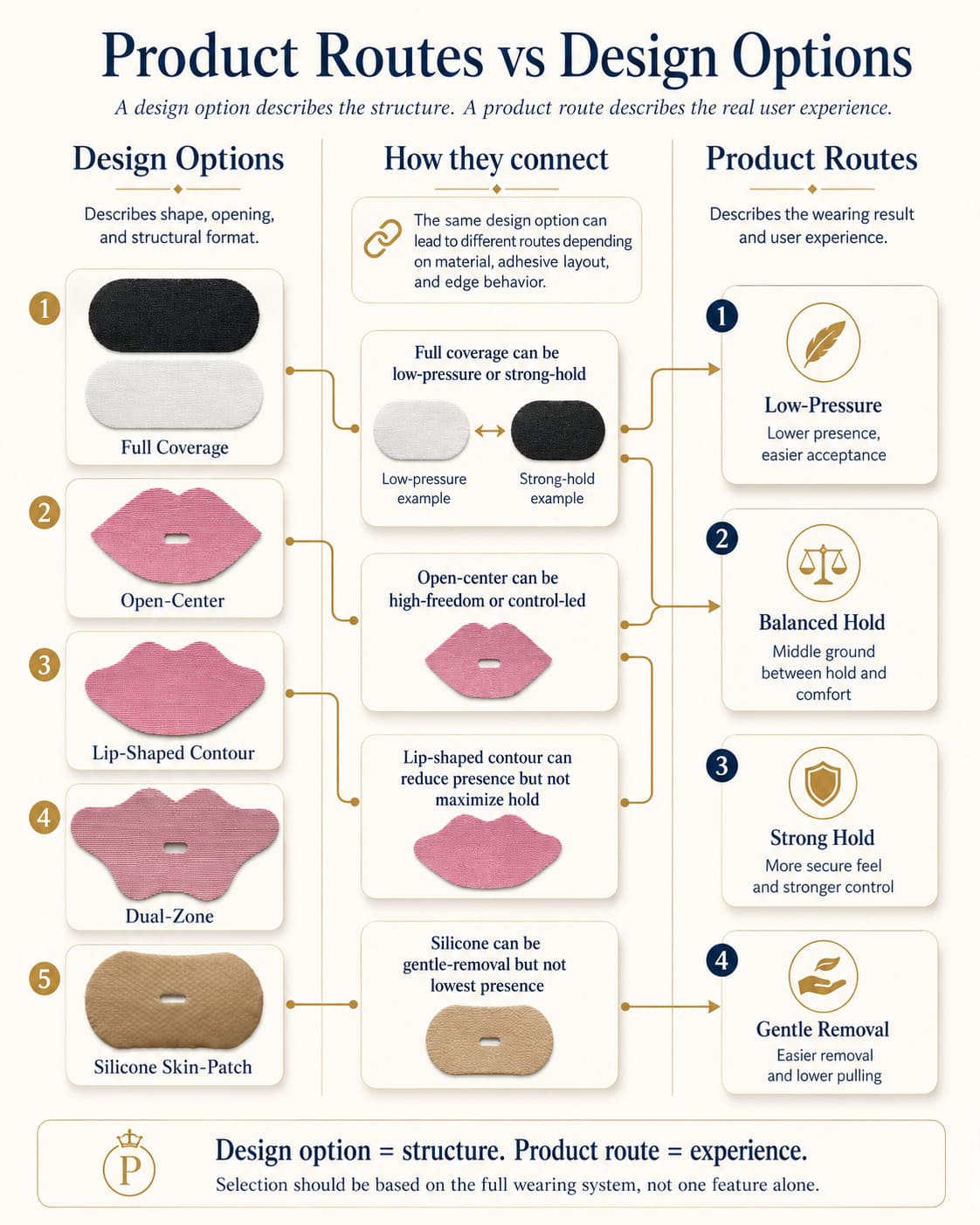
Product routes and design options are related, but they are not the same. A design option describes the structure. A product route describes the user experience.
Full coverage can be low-pressure or strong-hold
Open-center can be high-freedom or control-led
Silicone can be gentle-removal but not necessarily low-presence
Compact strip can be small but still not soft
Lip-shaped contour can reduce presence but may not be the strongest edge-control design
A buyer should not select mouth tape by one label only. The final product should match both design logic and target user route.
Private Label and
OEM Support
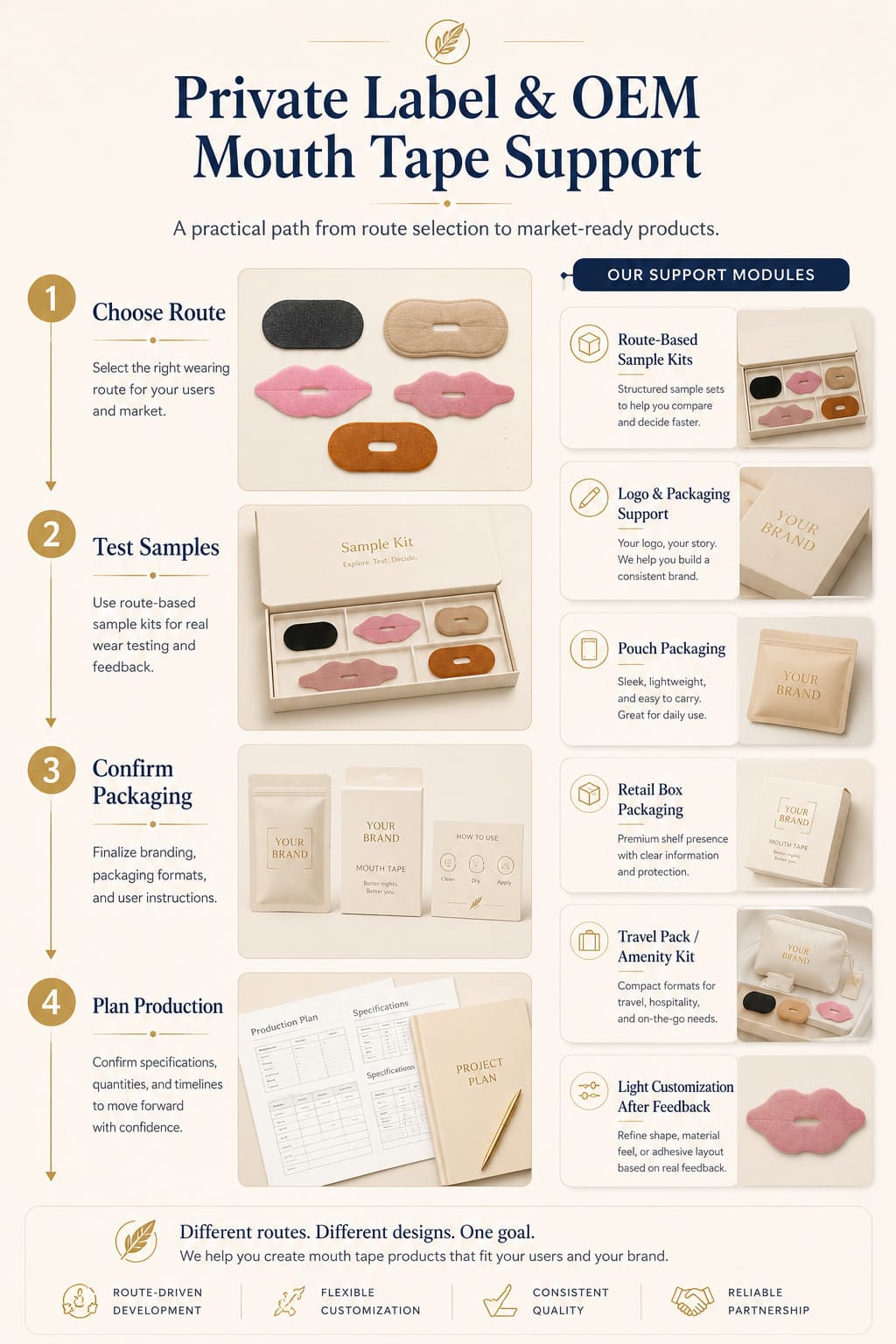
We support private label and OEM mouth tape projects with route-based sample selection, packaging planning, and manufacturer-backed production coordination.
For most buyers, the practical path is:
Route-Based Sample Kits
Most buyers should not start with one random sample. A route-based sample kit helps compare product directions before bulk production.
Basic Route Kit
Compare low-pressure, balanced hold, and strong hold.
Full Coverage vs Open-Center Kit
Compare unified coverage and central freedom.
Cotton vs Rayon Kit
Compare material feel direction.
Gentle Removal Kit
Compare removal comfort and beard-friendly options.
Design Logic Kit
Compare contour, adhesive layout, dual-zone, and compact formats.
Packaging Sample Kit
Compare pouch, box, travel pack, or kit formats.
A route-based sample kit helps buyers compare:
Nasal Strips and Sleep Kits
Mouth tape can also be part of a broader sleep or wellness accessory line. Some buyers may want to combine mouth tape with nasal strips, especially for travel kits, sleep starter kits, hospitality amenity kits, wellness retail bundles, or premium sleep accessory sets.
Nasal Strips
Nasal strips should not be treated as random add-ons. The packaging should explain their role in the routine and how they differ from mouth tape.
View Nasal StripsSleep Kits & Accessories
Sleep kit and bundle planning may include mouth tape, nasal strips, individual sachets, instruction cards, travel pouches, retail boxes, and amenity kit packaging.
View Sleep Kits
How to Choose the Right
Mouth Tape Product
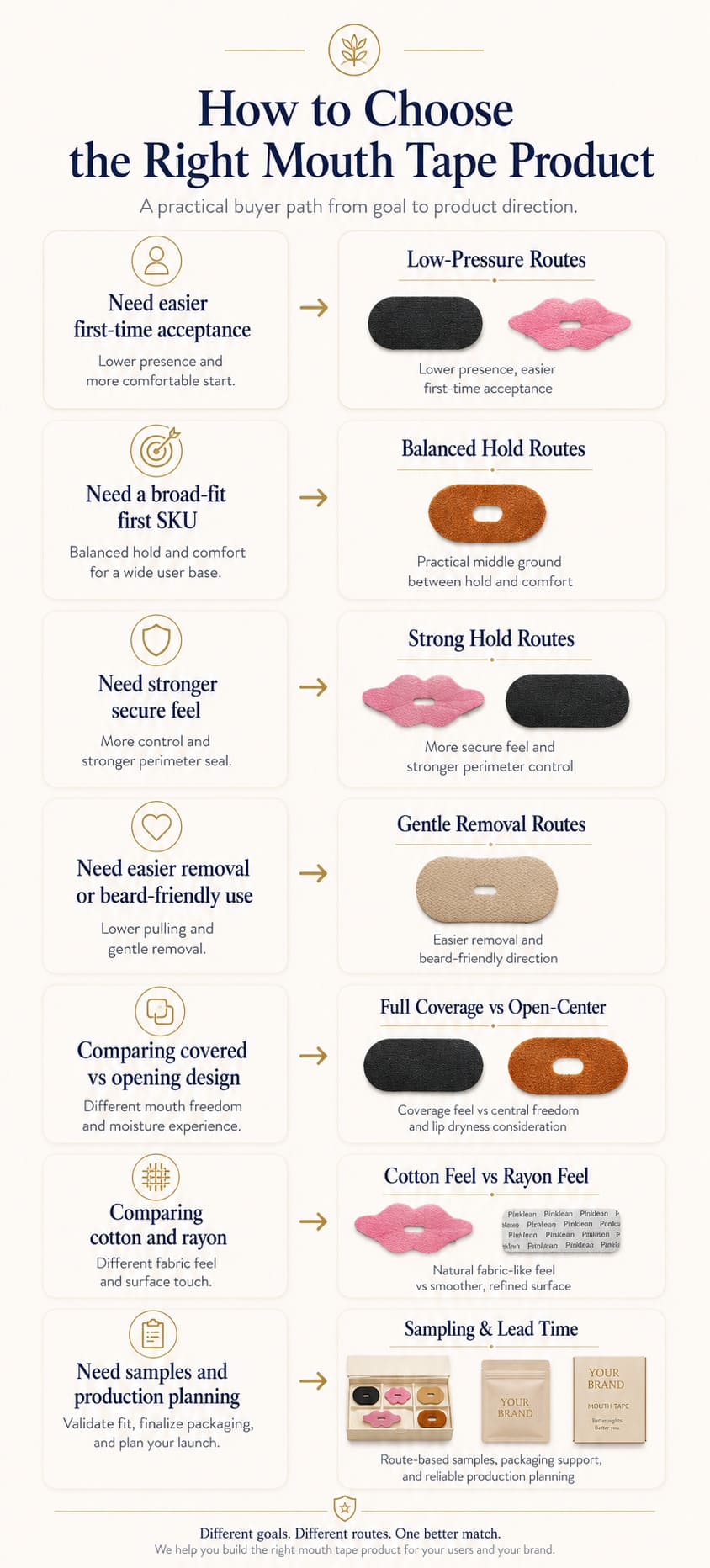
If you are not sure where to start, use the buyer path below. This table helps buyers avoid jumping directly into a final product before understanding the route.
Need a general product overview
→ Mouth Tape Products
Need easier first-time acceptance
→ Low-Pressure Routes
Need a broad-fit first SKU
→ Balanced Hold Routes
Need stronger secure feel
→ Strong Hold Routes
Need easier removal or beard-friendly use
→ Gentle Removal / Beard-Friendly Routes
Unsure how to choose route
→ Mouth Tape Route Selection Guide
Comparing covered vs opening design
→ Full Coverage vs Open-Center
Concerned about opening size or lip dryness
→ Opening Size & Airflow
Comparing cotton and rayon
→ Cotton Feel vs Rayon Feel
Need custom shape / material / adhesive
→ Mouth Tape Customization Options
Need pouch, box, kit, or branding
→ Packaging & Branding
Need samples and production planning
→ Sampling & Lead Time
Need OEM support
→ Private Label Mouth Tape Manufacturer
Request Route-Based
Mouth Tape Samples
If you are building a private label mouth tape product line, the best next step is to compare product routes. Send us your target user group, brand positioning, preferred route direction, comfort vs security priority, and packaging format.
We can recommend a route-based sample set based on your target market and product plan.
Send us your brief
Related Pages & Guides
Product Routes
Selection Guide
Private Label / OEM
Related Products
Frequently Asked
Questions
Common questions from private label buyers about mouth tape products, routes, materials, and OEM support.
Ask a QuestionWhat types of mouth tape products do you supply?
We supply private label mouth tape products organized by product routes, including low-pressure, balanced hold, strong hold, gentle removal, full coverage, open-center, and related design options.
Do you offer private label mouth tape?
Yes. We support private label mouth tape projects with route-based sample selection, packaging support, light customization, and manufacturer-backed production coordination.
What is the difference between mouth tape product routes and materials?
Material describes what the patch is made from. Product route describes how it feels and behaves on the face. The final mouth tape experience depends on material, adhesive, shape, size, opening, edge behavior, and removal profile.
Can I choose full coverage or open-center mouth tape?
Yes. Full coverage and open-center are both available route directions. Full coverage gives a more unified patch feel, while open-center can offer more central mouth freedom but may also increase lip dryness.
Which mouth tape is better for first-time users?
Low-pressure routes or balanced routes are usually better starting points for first-time users because they reduce psychological burden and feel easier to accept.
Which mouth tape is better for stronger hold?
Strong hold routes are better when the product needs more security, stronger perimeter control, and a more locked-in wearing feel.
Do you offer gentle removal or beard-friendly mouth tape?
Yes. Gentle removal and beard-friendly routes can be discussed, including silicone skin-patch style products and other softer-removal directions.
Can mouth tape be packed with nasal strips?
Yes. Mouth tape and nasal strips can be combined into sleep kits, travel kits, wellness bundles, or hospitality amenity kits when the packaging explains the routine clearly.
What is the best first step for a private label buyer?
The best first step is to request a route-based sample kit. This allows buyers to compare different product routes before choosing final packaging, customization, and bulk order direction.
Try Before You Commit
Request a curated sample kit with representatives from each route. The most practical first step for any private label buyer.