Strong Hold
Mouth Tape Routes
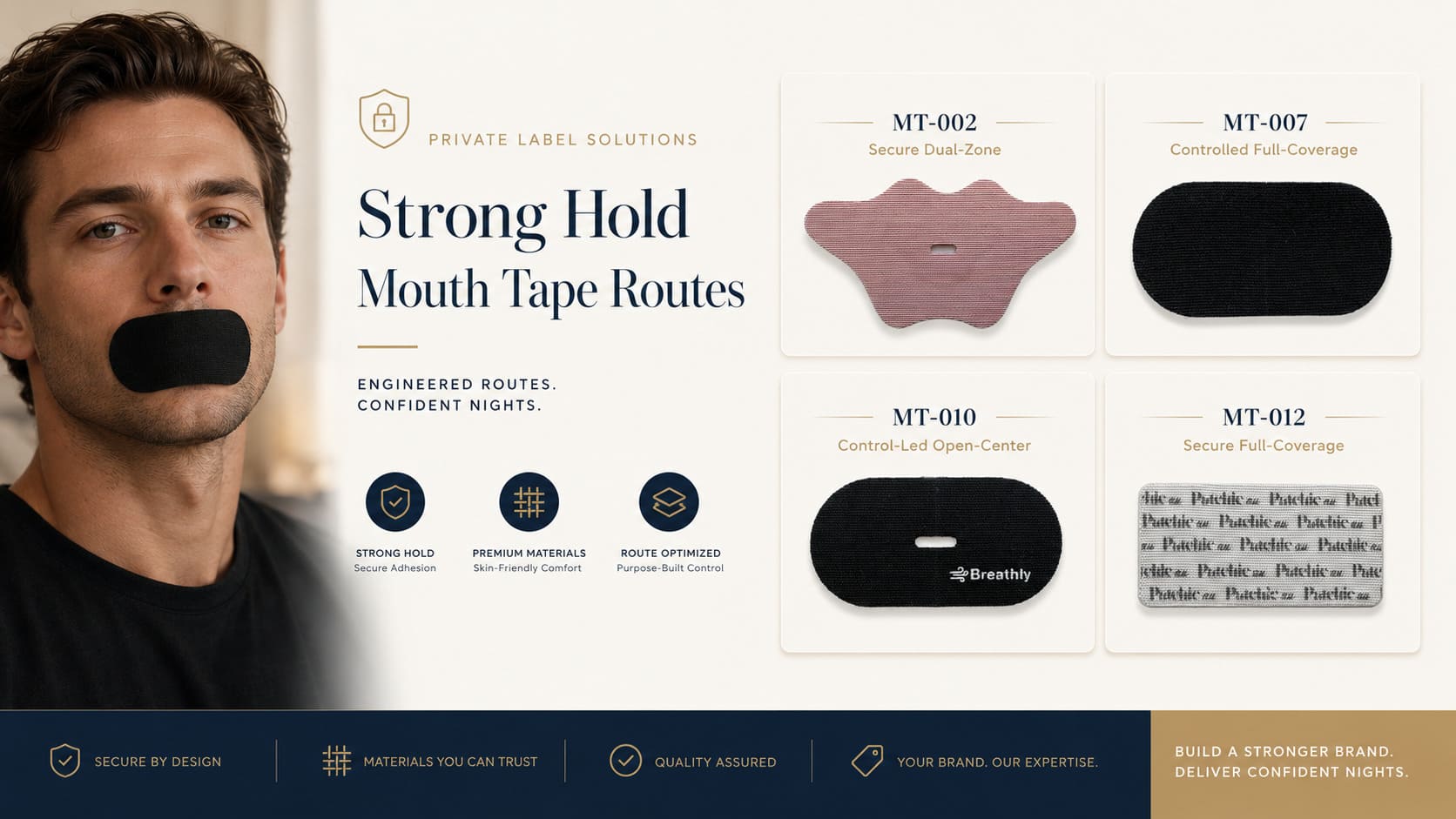
For private label buyers who need stronger hold, higher security, and a more controlled overnight mouth tape experience.
Some users do not want the lightest-feeling mouth tape. They want to feel that the patch is really staying in place. Strong Hold Routes are built for product lines where security matters more than minimal presence.
Strong Hold Is a Route,
Not Just a Glue Claim
Some users do not want the lightest-feeling mouth tape.
They want to feel that the patch is really staying in place.
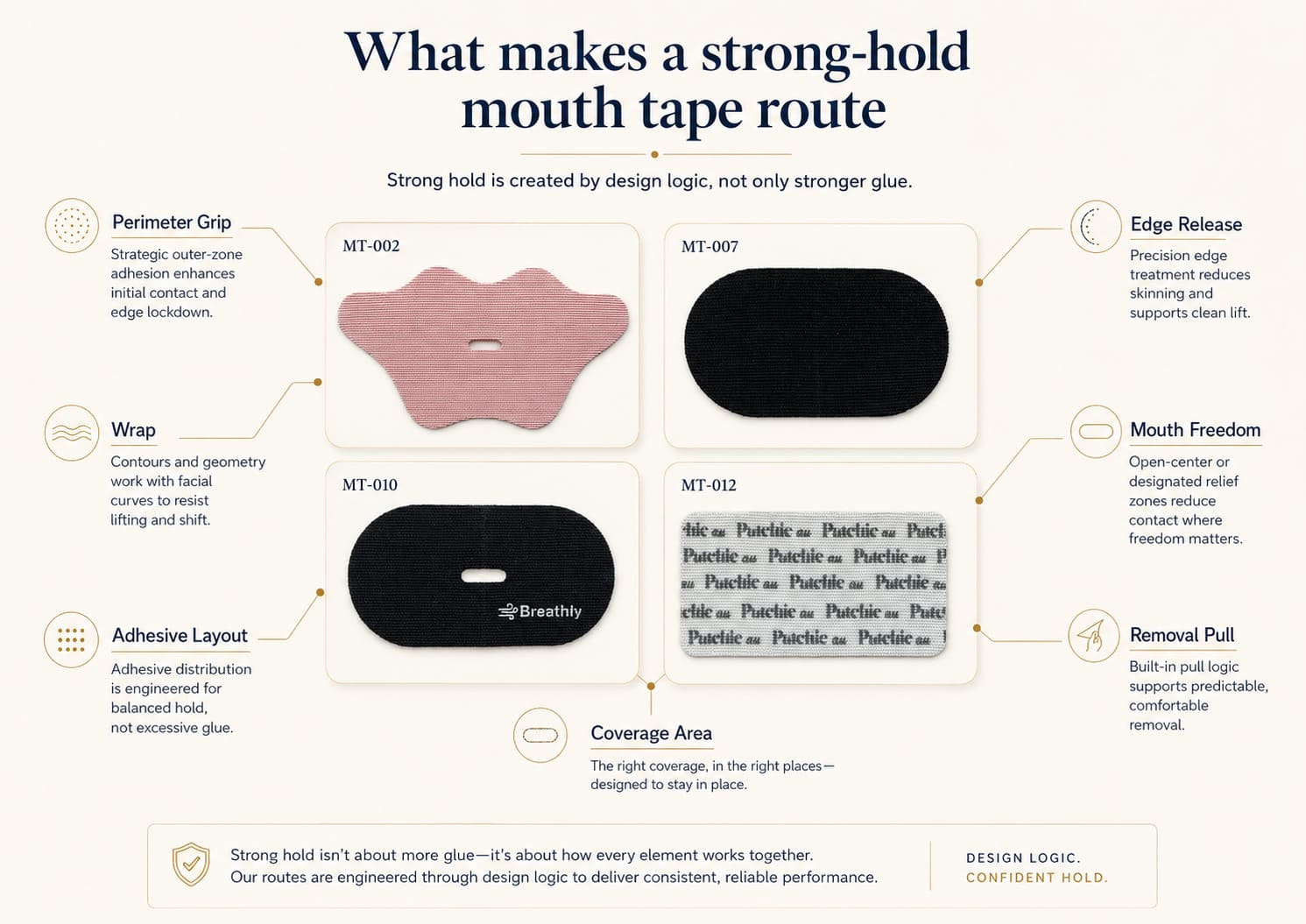
Strong Hold Routes are built for product lines where security matters more than minimal presence. These routes usually create stronger perimeter control, more wrap, less edge release, and a clearer "locked-in" feeling during wear.
This does not mean every strong-hold patch should feel harsh.
A good strong-hold route should feel secure without turning into a sports-tape experience. That difference matters.
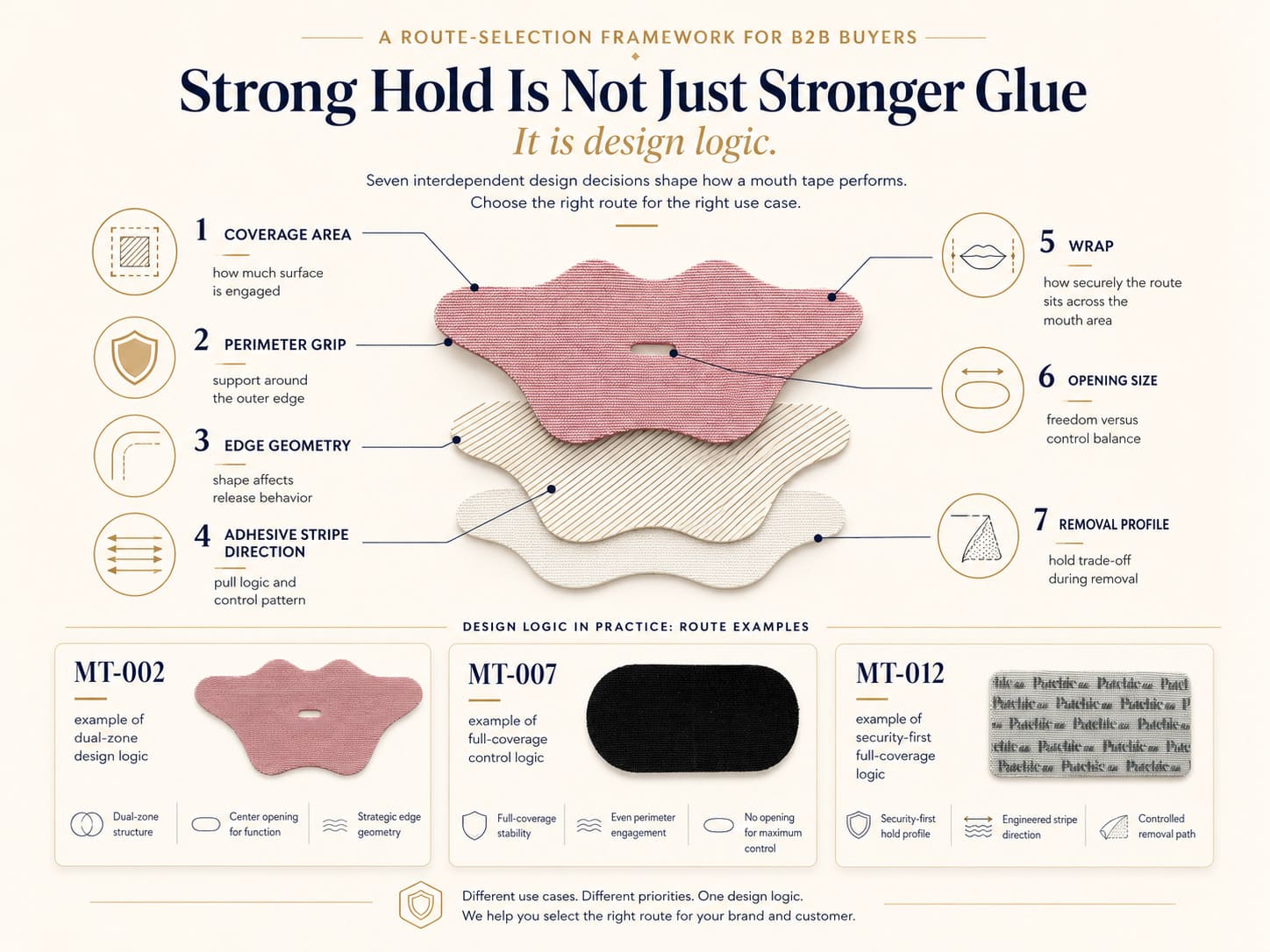
For B2B buyers, strong hold is not just an adhesive claim. It is a product route. It depends on coverage, contour, edge behavior, backing structure, adhesive layout, and how the patch responds during chewing, pouting, and small mouth movements.
What "Strong Hold" Means
in Mouth Tape Selection
Strong hold does not simply mean "use stronger glue." In real use, a mouth tape can feel more secure for several reasons.
A strong-hold route should give the user more confidence that the patch will not loosen during the night. But this usually comes with trade-offs: more presence, lower freedom, and sometimes more pulling during removal.
For buyers, the question is not simply: "Which one sticks the strongest?"
The better question is: "Which strong-hold route gives the right level of control for our target users?"
How We Identify
a Strong Hold Route
Supplier pages often use words like strong adhesive, long-lasting hold, skin-friendly, and overnight use. Those words are not enough.
For strong-hold selection, we look at what happens when the patch is actually worn:
- Does the perimeter stay engaged during chewing or pouting?
- Does the patch reduce edge release compared with lighter routes?
- Does the user feel more secure in static wear?
- Does the patch create inward pulling or horizontal gathering?
- Does stronger stability come from shape, coverage, adhesive layout, or material stiffness?
- Does removal remain acceptable, or does the stronger hold create too much pulling?
- Does the experience still feel like a sleep product, or does it become too functional?
A patch can feel secure because it is larger. Another can feel secure because its edge geometry works better. Another can feel secure because the adhesive stripe pattern creates stronger gathering. Another can feel secure because the central opening is smaller.
The real difference is not the label. It is how the patch behaves on the mouth.
Best-Fit Buyer Profiles
Strong Hold Routes are best suited for buyers who want a clearer control message.
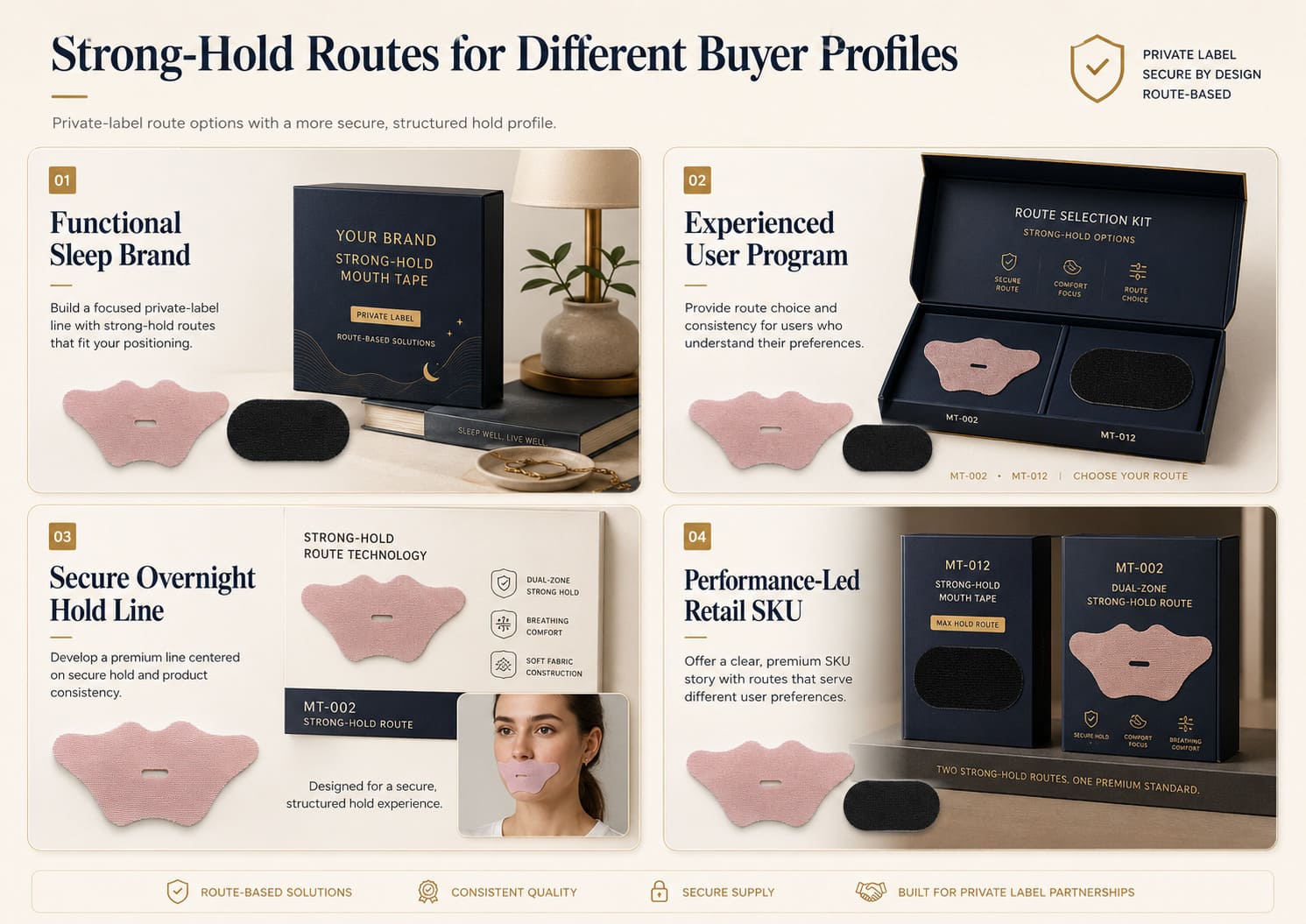
Experienced User Programs
For private label brands targeting users who already understand mouth tape and want a more secure route option.
Functional Sleep Product Lines
For brands where secure overnight hold and product consistency are part of the core value proposition.
Secure Overnight Hold Lines
For buyers who want "secure overnight hold" as a clear product message without moving into a harsh or sports-tape-like feel.
Performance-Led Retail SKUs
For distributors and retail buyers looking for a more control-led SKU with a stronger hold profile.
Reassurance-First Product Lines
For product lines where stronger reassurance matters more than the lowest possible presence.
- First-time-user-first programs
- Hospitality trial kits where low psychological pressure matters more
- Comfort-first sleep & wellness branding
- Users who dislike a more restrictive mouth feel
Strong hold can help with confidence. But it should not be positioned as automatically better for every user.
Candidate Product Routes
Below are current examples that fit the Strong Hold direction. These are not "consumer recommendations." They are product-route examples for private label selection.
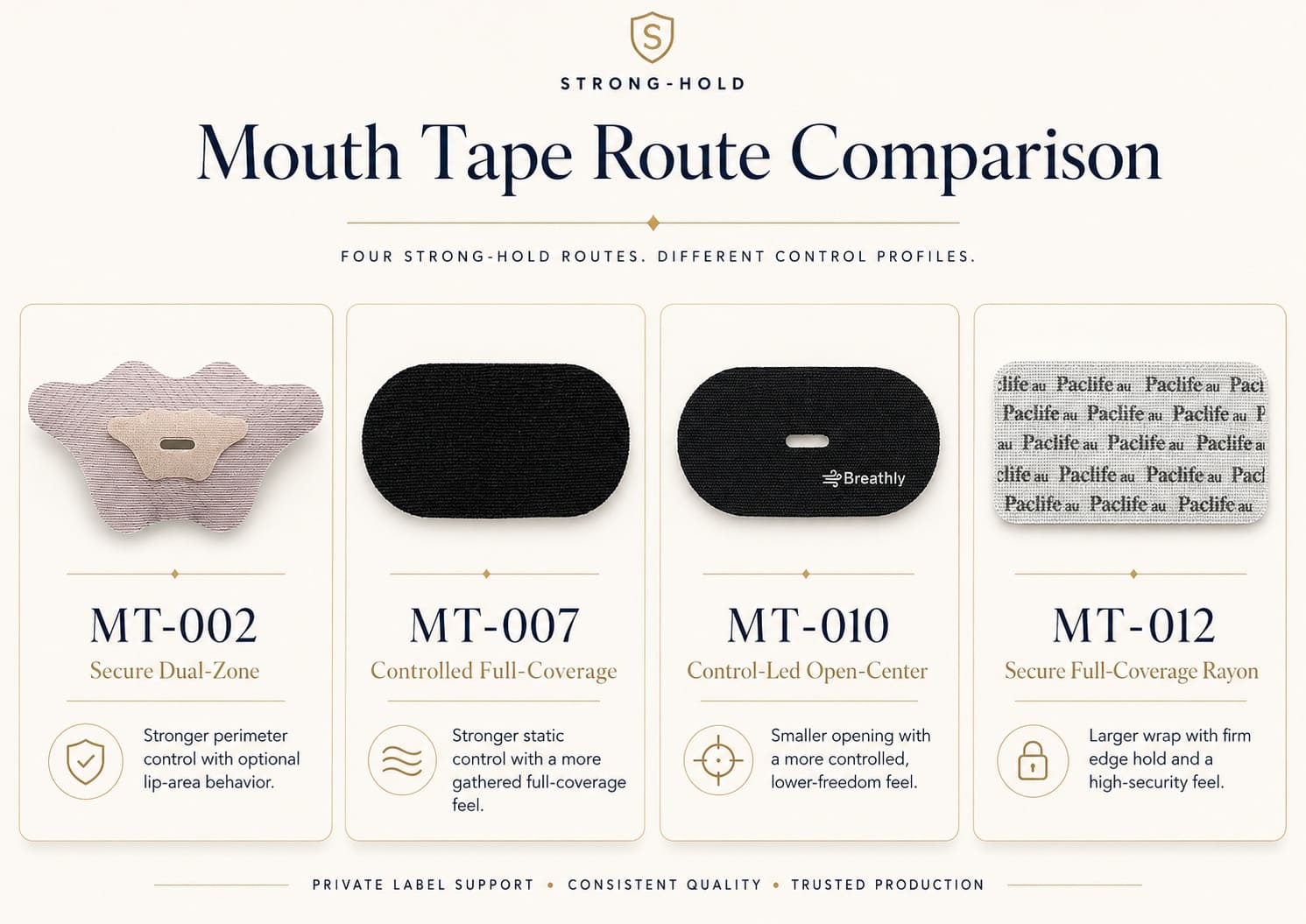
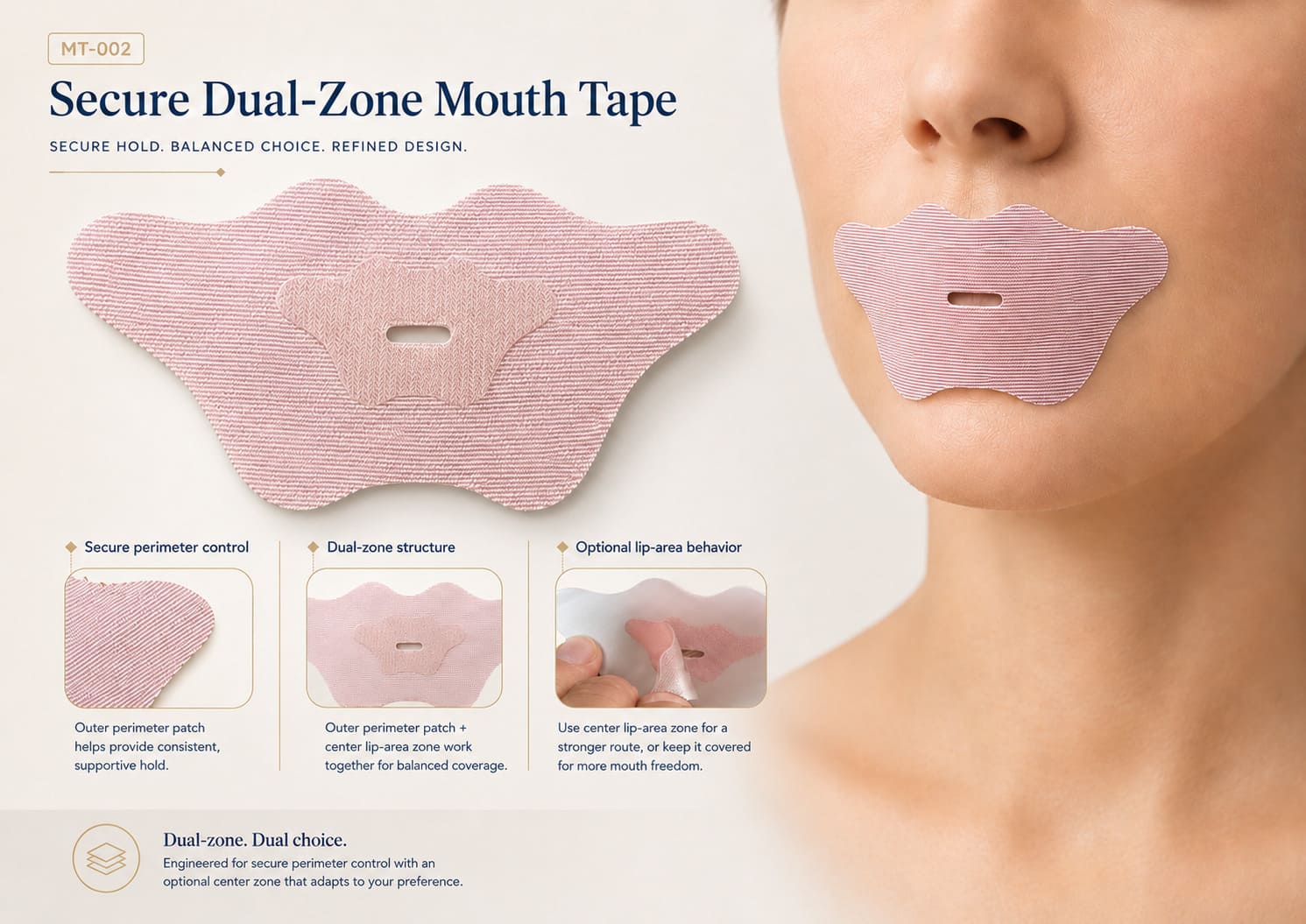
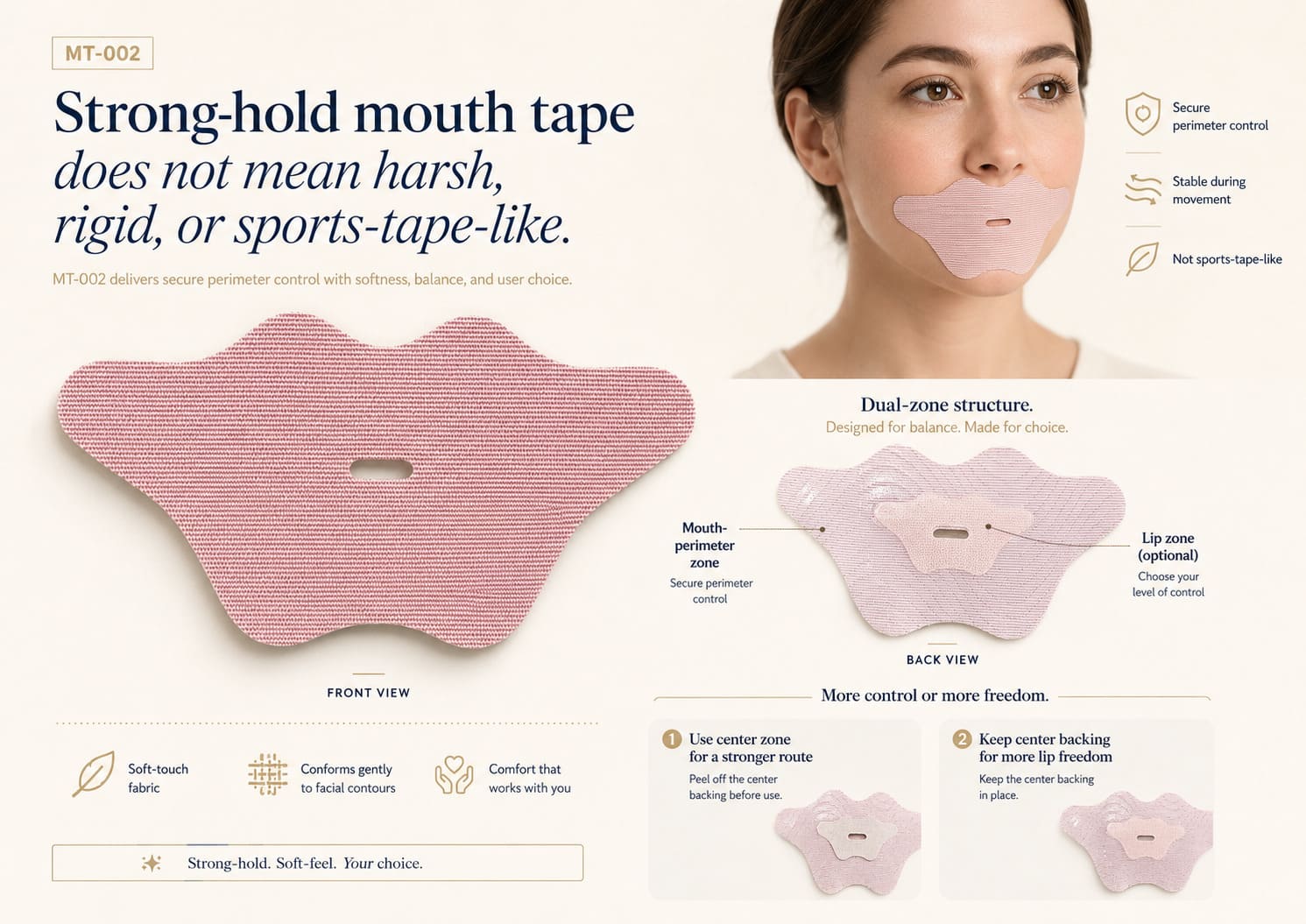
MT-002 -- Secure Dual-Zone Route
MT-002 is one of the strongest examples of secure perimeter control without feeling like a sports tape. Its key design difference is the dual-zone structure. The lip-area insert and outer perimeter patch create optional behavior: some users may prefer the lip area to stay non-adhesive, while others may choose to expose adhesive across the lip zone.
In real wear, MT-002 has stronger perimeter hold than low-pressure styles. During chewing, pouting, and other mouth movements, the perimeter stays more stable and does not noticeably collapse.
- Stronger overnight reassurance
- Clear perimeter control
- A differentiated product structure
- Optional lip-area adhesion logic
- Stronger hold without obvious elastic pulling
MT-002 has slightly higher presence and a firmer feel than softer, thinner routes.
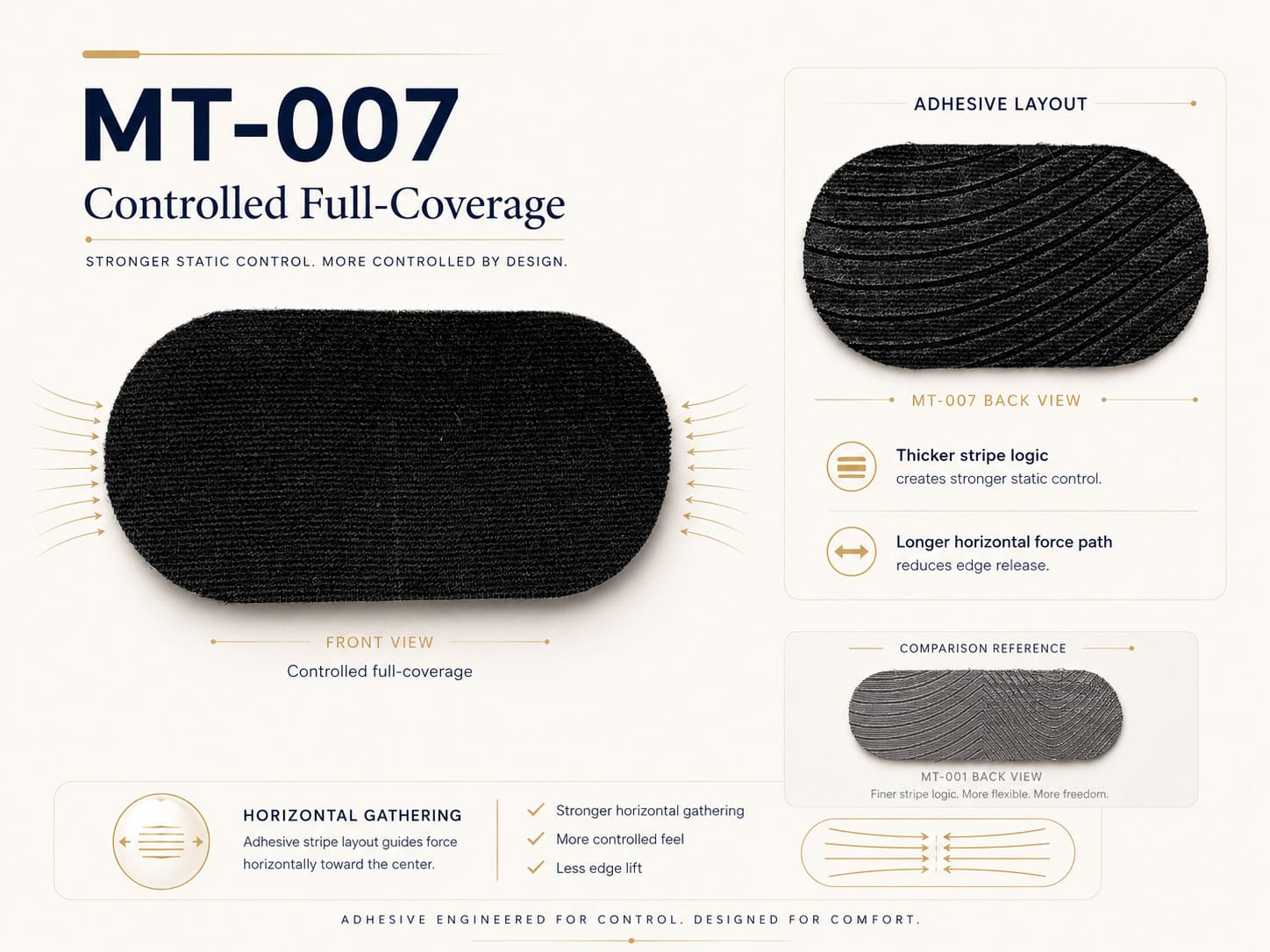
MT-007 -- Controlled Full-Coverage Route
MT-007 is especially useful because it proves that strong hold is not only about material. It shares a similar material, size, color, and full-coverage format with MT-001, but the back adhesive stripe pattern is different. In wear, MT-007 feels more horizontally gathered, as if the mouth area is being drawn inward toward the center.
Compared with MT-001, it feels more sealed, more controlled, and less free.
- The same general full-coverage family as a lighter patch
- Stronger static control
- Less edge release
- More secure attachment
- A control-first feel without changing into a completely different product type
MT-007 feels less relaxed and carries more psychological weight than MT-001.
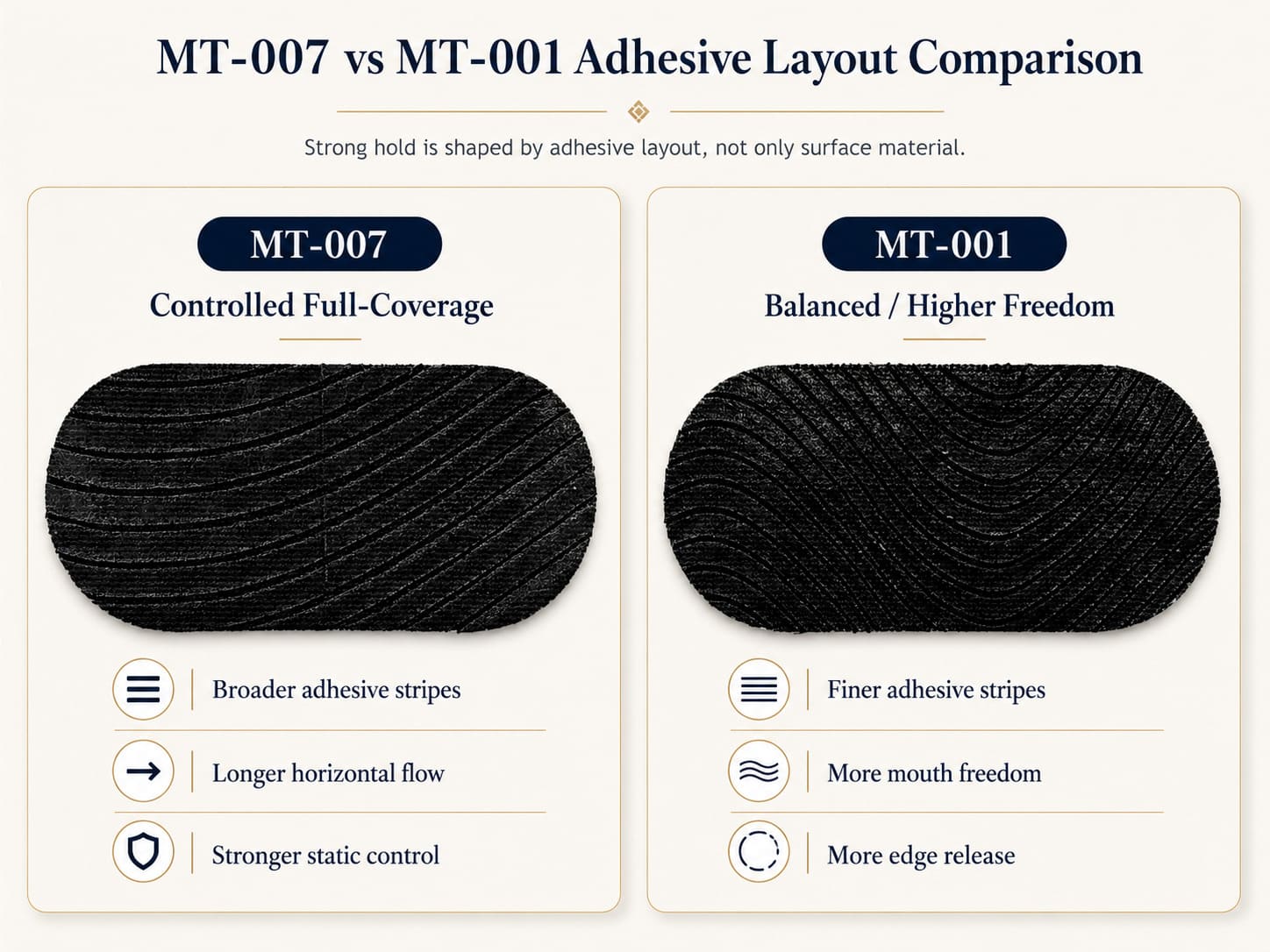
This comparison is useful because it shows that similar front appearance does not always mean similar wear behavior. Adhesive layout and force direction can change the user experience.
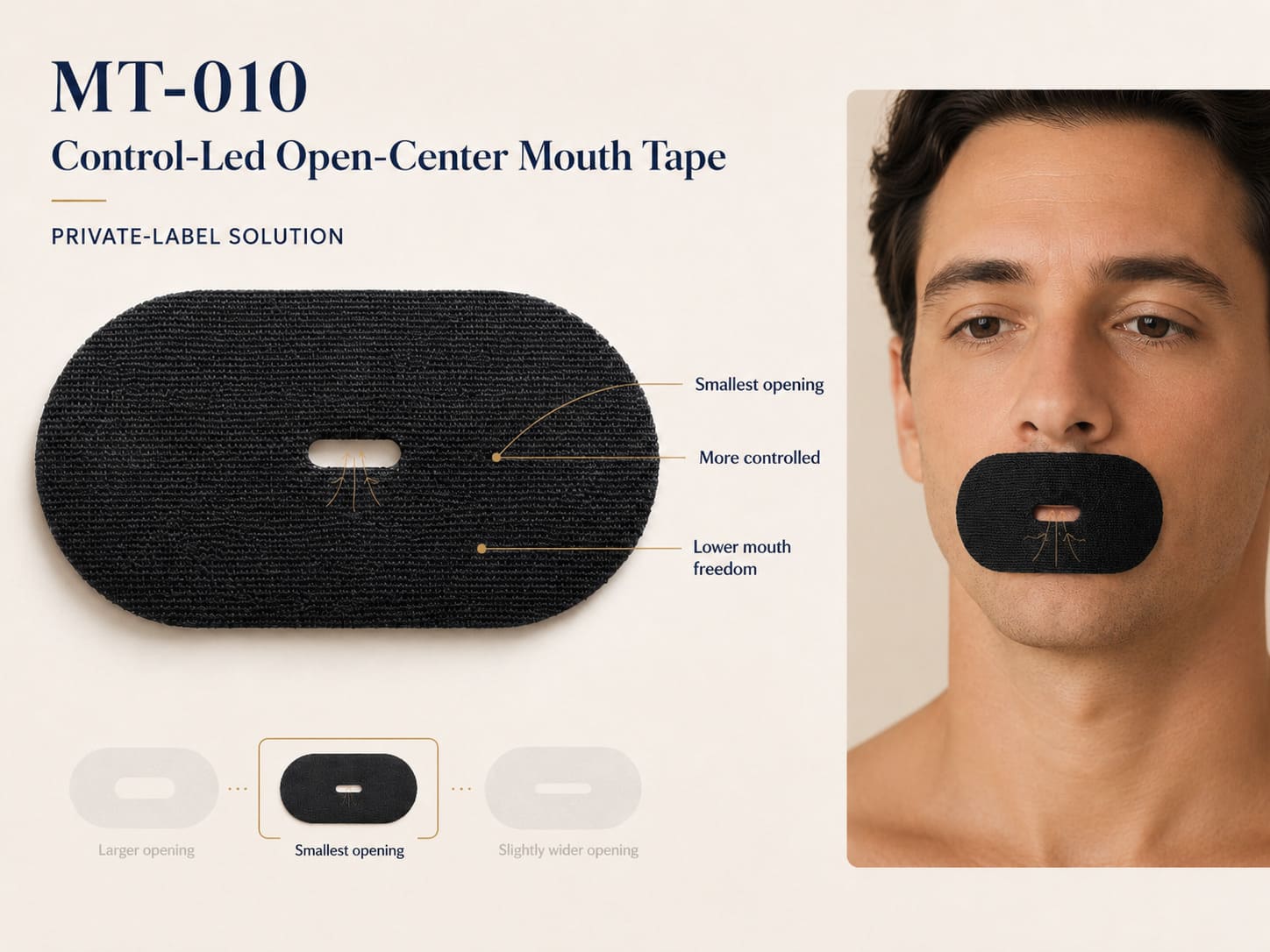
MT-010 -- Control-Led Open-Center Route
MT-010 sits inside the open-center family, but it is the most control-led option in that group. It has the smallest central opening among MT-010 / MT-009 / MT-008, which means less mouth freedom and higher presence. It still uses an open-center logic, but the smaller opening makes the design feel more closed and more controlled than larger-opening versions.
- An open-center format
- Stronger control than more open variants
- Less mouth freedom
- A more secure feeling within the open-center family
MT-010 has the highest presence and lowest freedom in that open-center set. It also carries the lip-dryness trade-off common to open-center designs, because airflow remains concentrated through the exposed opening area.
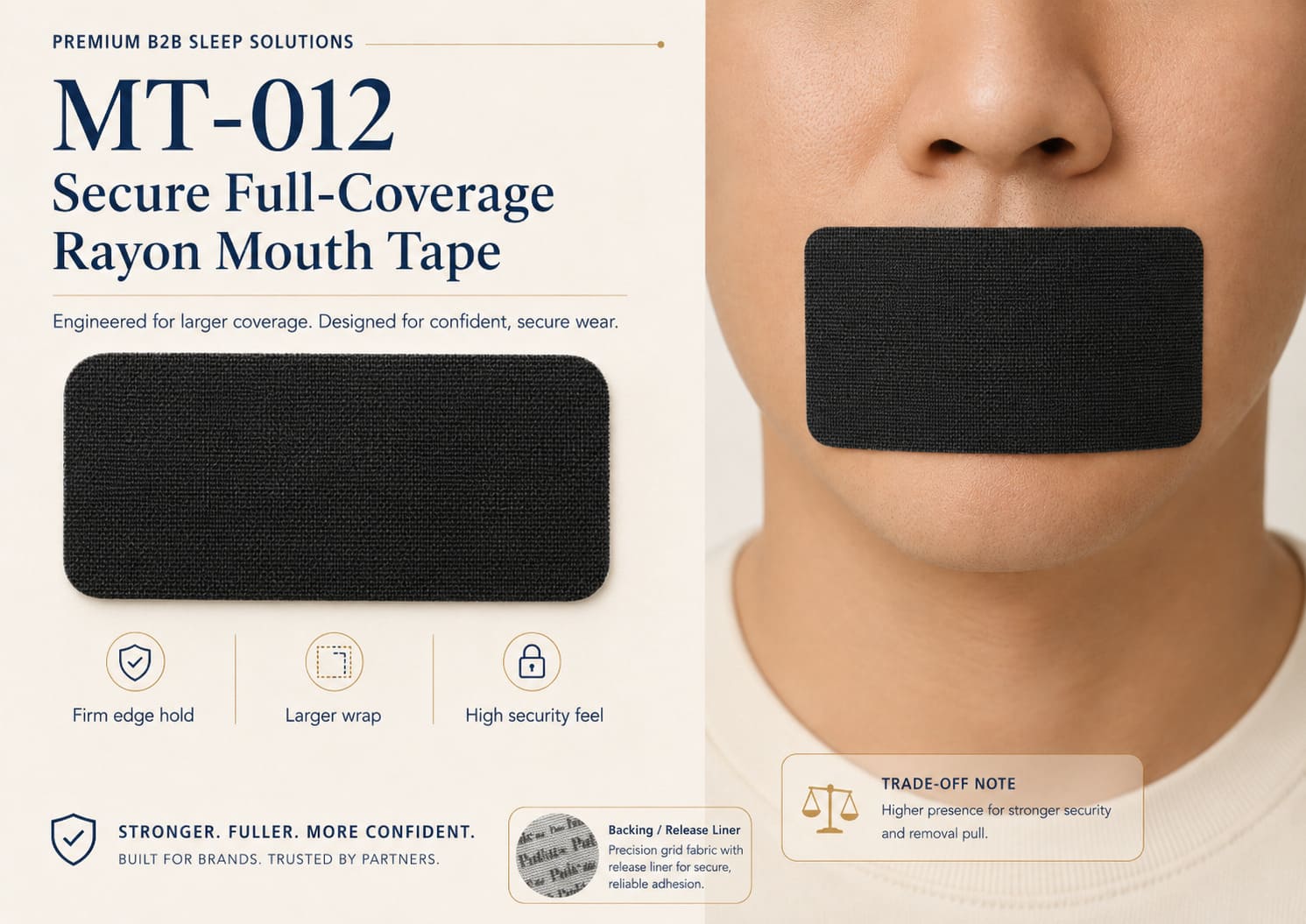
MT-012 -- Secure Full-Coverage Rayon Route
MT-012 is a strong-hold full-coverage rayon strip. It is larger, more enclosing, and more security-oriented than lighter full-coverage routes. It creates a strong wrapped feeling, firm edge adhesion, and a clear sense that the patch will not easily loosen or fall off.
This route is not the softest or the most breathable-feeling. It is more controlled, more present, and lower in freedom.
- Strong full-coverage hold
- High security feeling
- Less risk of edge loosening
- Clear control-first positioning
- A product route for users who prioritize "stays on" over lowest presence
MT-012 has stronger removal pull and higher psychological presence. This is not the easiest route for first-time users, but it can be the right route for security-first users.
Route Comparison
A quick-reference guide for B2B buyers comparing strong-hold route options.
| Route Example | Best Fit | Presence | Hold Feel | Main Trade-Off |
|---|---|---|---|---|
| MT-002 | Secure dual-zone route | Medium | High | Larger format / stronger presence |
| MT-007 | Controlled full-coverage route | Medium | High | Horizontal gathering feel |
| MT-010 | Control-led open-center route | High | Medium / High | Lowest freedom in open-center group |
| MT-012 | Strong full-coverage route | High | High | Stronger removal pull |
Use this comparison as a route-selection starting point, not as a universal ranking. The right route depends on target users, packaging promise, expected wear behavior, and acceptable trade-offs.
Trade-Offs Buyers
Should Understand
Strong Hold Routes are useful when the end user wants security. But security has a cost.
A stronger-hold patch may feel more reassuring, but it may also create:
- Higher presence
- Lower mouth freedom
- Stronger edge awareness
- Heavier psychological control
- Stronger removal pull
- Less suitability for first-time users
That does not make the route bad. It simply means it should be positioned correctly.
A strong-hold product is usually easier to sell when the brand message is clear:
- Secure overnight hold
- More controlled feel
- Less edge release
- Stronger wrap
- Higher confidence
It is less effective when the brand is trying to feel soft, effortless, invisible, or starter-friendly.
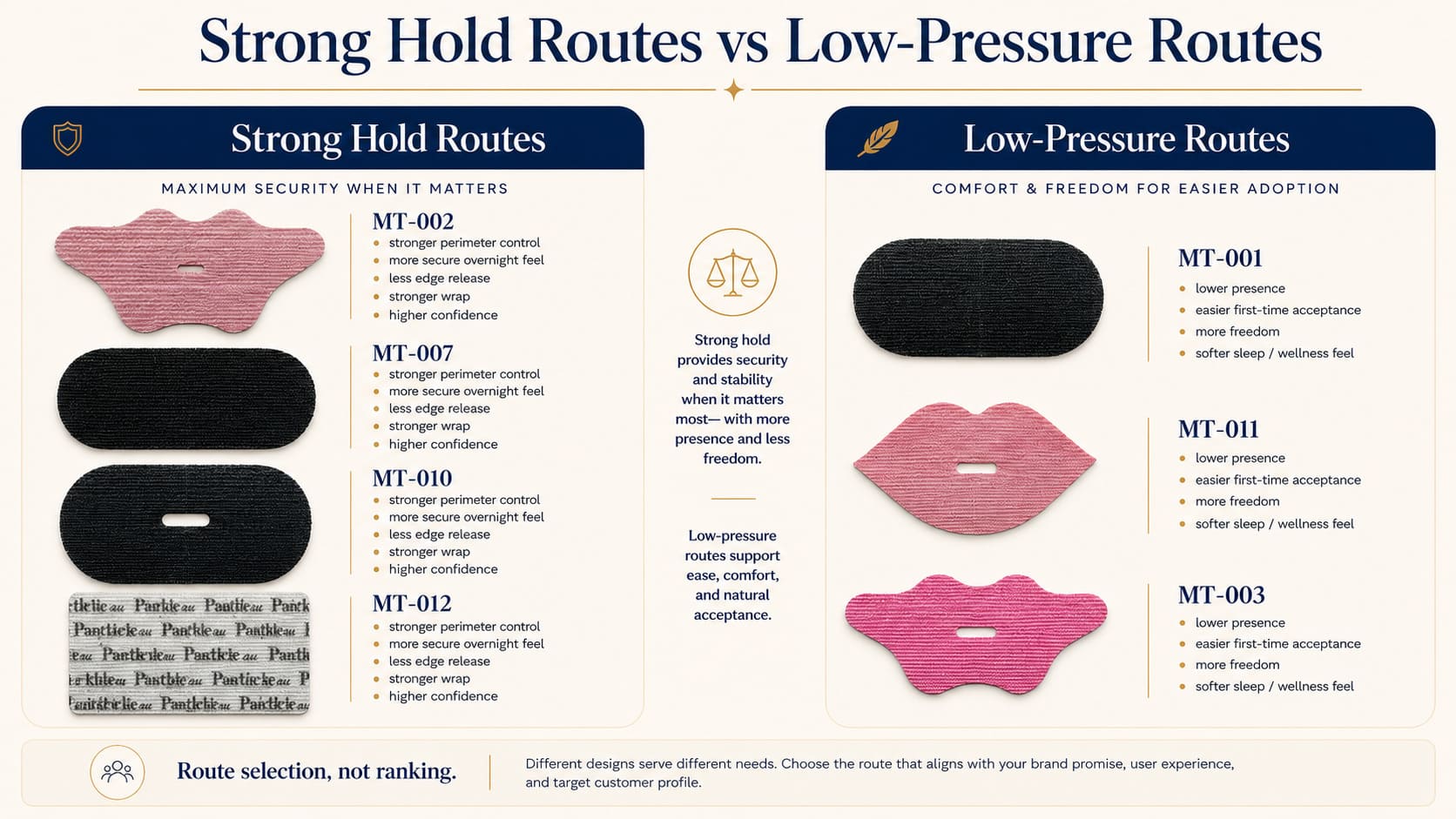
When to Choose
This Route
Choose a Strong Hold Route if your product goal is:
- Stronger overnight security
- More controlled mouth feel
- Less edge release during movement
- Higher user confidence that the patch will stay in place
- A more functional or hold-first product line
- A product for experienced mouth tape users
Choose another route if your goal is:
- Lower psychological pressure
- First-time user acceptance
- Softer sleep & wellness positioning
- Maximum freedom
- Gentler removal as the primary value
B2B Selection Notes
For private label buyers, strong hold can be a strong selling point, but it should not be the only filter.
The right question is not: "Which patch holds the strongest?"
The better question is: "Which hold profile fits the end user and the brand promise?"
May want the most secure full-coverage route.
May want strong hold, but not a heavy control feel.
May include both low-pressure and strong-hold routes so the buyer can see how different user groups respond.
Responsible Wellness Positioning
For private label buyers, stronger hold is only one part of product route selection. The product message also needs to stay responsible. Mouth tape should be positioned as a sleep and wellness accessory route, not as a medical treatment.
Authoritative sleep and health sources discuss mouth taping with caution, especially for people with snoring, breathing problems, or suspected sleep apnea. For this reason, this page keeps the product language focused on route selection, comfort trade-offs, secure wear behavior, and private label positioning rather than treatment claims.
Because mouth tape is applied to facial skin, buyers should evaluate adhesive feel, removal comfort, and skin sensitivity, not only hold level. Published medical adhesive tape research has compared adhesive tape types for facial use and skin injury risk, which supports the broader point that adhesive choice and removal profile matter.
Comparison of Medical Adhesive Tapes in Patients at Risk of Facial Skin TraumaPrivate label packaging should avoid disease diagnosis, treatment, or cure claims. A safer route is to position the product around general wellness, comfort, user acceptance, secure wear behavior, and routine support.
FDA -- General Wellness: Policy for Low Risk Devices
Request Strong Hold
Route Samples
Need a stronger mouth tape route for your private label program? Send us your target user, preferred control level, packaging plan, and whether your brand leans toward functional sleep support or premium sleep and wellness positioning.
We can recommend strong-hold samples based on fit, perimeter control, freedom, removal comfort, and private label fit.
Frequently Asked Questions
B2B-focused answers for private label buyers evaluating strong-hold mouth tape routes.