How We Evaluate
Mouth Tape Samples
Wear-behavior evaluation for private label mouth tape selection -- not consumer ranking.
Mouth tape sample testing should not be treated as a simple "which one is best" exercise.
For private label buyers, the real question is different: which mouth tape route fits the target users, product positioning, packaging direction, and sample-to-bulk plan?
That is why we evaluate mouth tape samples by real wearing behavior, not by material names alone.
This method is used for B2B product route selection, not medical claims or consumer product ranking.
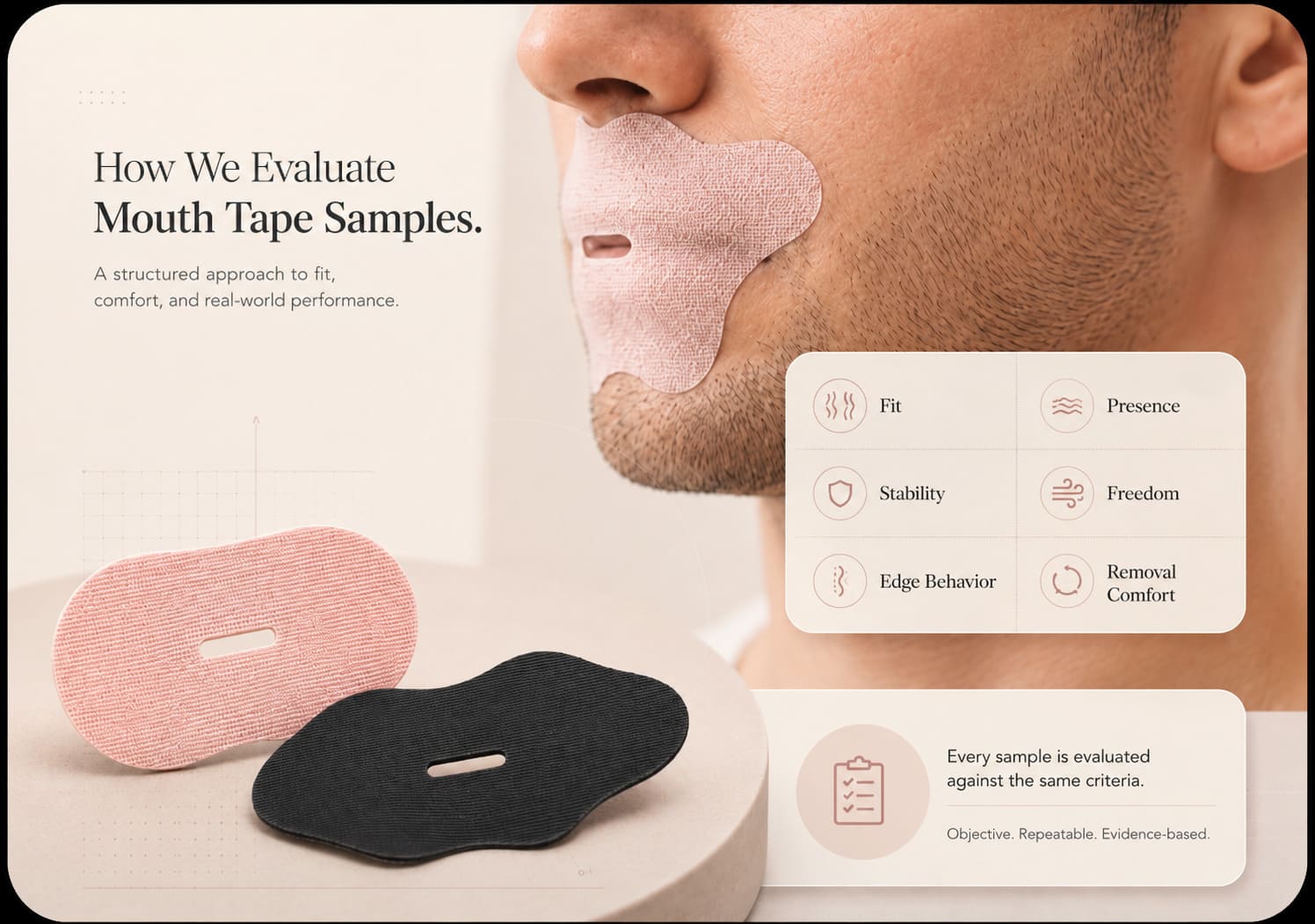
Evaluation Scope
Our current mouth tape evaluation system is based on internal sample references covering full-coverage routes, open-center routes, lip-shaped contour routes, dual-zone routes, silicone skin-patch routes, compact strip formats, cotton / fabric routes, rayon / bamboo-silk-style routes, spunlace non-woven routes, and different adhesive layout behaviors.
The observations are used for private label route selection. They are not consumer rankings, medical claims, or clinical test results.
A Product Route
Evaluation Method
A mouth tape may be described as cotton, rayon, silicone, non-woven, hydrogel, or fabric-based. Those words are useful, but they do not fully explain how the product behaves on the face.
The actual wearing experience is shaped by a combination of factors that go beyond material name.
This page explains how we evaluate mouth tape samples for B2B product selection.
It is not a consumer review system.
It is a product route evaluation method.
This Is Not a
Consumer Review System
We do not evaluate mouth tape samples to rank them as "best" or "worst."
A sample that is not ideal for one route may still be useful for another route.
- a softer full-coverage product may be good for low-pressure positioning
- a stronger perimeter-control product may be good for strong-hold positioning
- a silicone route may not feel the thinnest during wear, but may remove very gently
- an open-center product may increase central mouth freedom, but may also increase lip dryness
- a compact strip may look light, but still feel dry or firm in real wear
"This is why our language focuses on route fit, not consumer ranking."
Why Sample Testing
Matters
Mouth tape looks simple, but small design differences can change the wearing experience.
A buyer may see two samples that look similar, but they may feel different because of:
For private label buyers, this matters because choosing the wrong route can create problems later:
- a comfort-first brand may choose a product that feels too restrictive
- a security-first brand may choose a product that feels too relaxed
- an open-center product may be marketed as breathable, but users may report lip dryness
- a product may hold well, but users may dislike removing it
- packaging may promise one experience while the product delivers another
Sample testing reduces these risks.
Identify which route direction fits the brand positioning.
Confirm the route fits the intended user's comfort and needs.
Align the packaging promise with the product's real behavior.
Decide what to customize and what to leave as standard.
Move to production with confidence based on confirmed samples.
Static Wear vs
Dynamic Movement
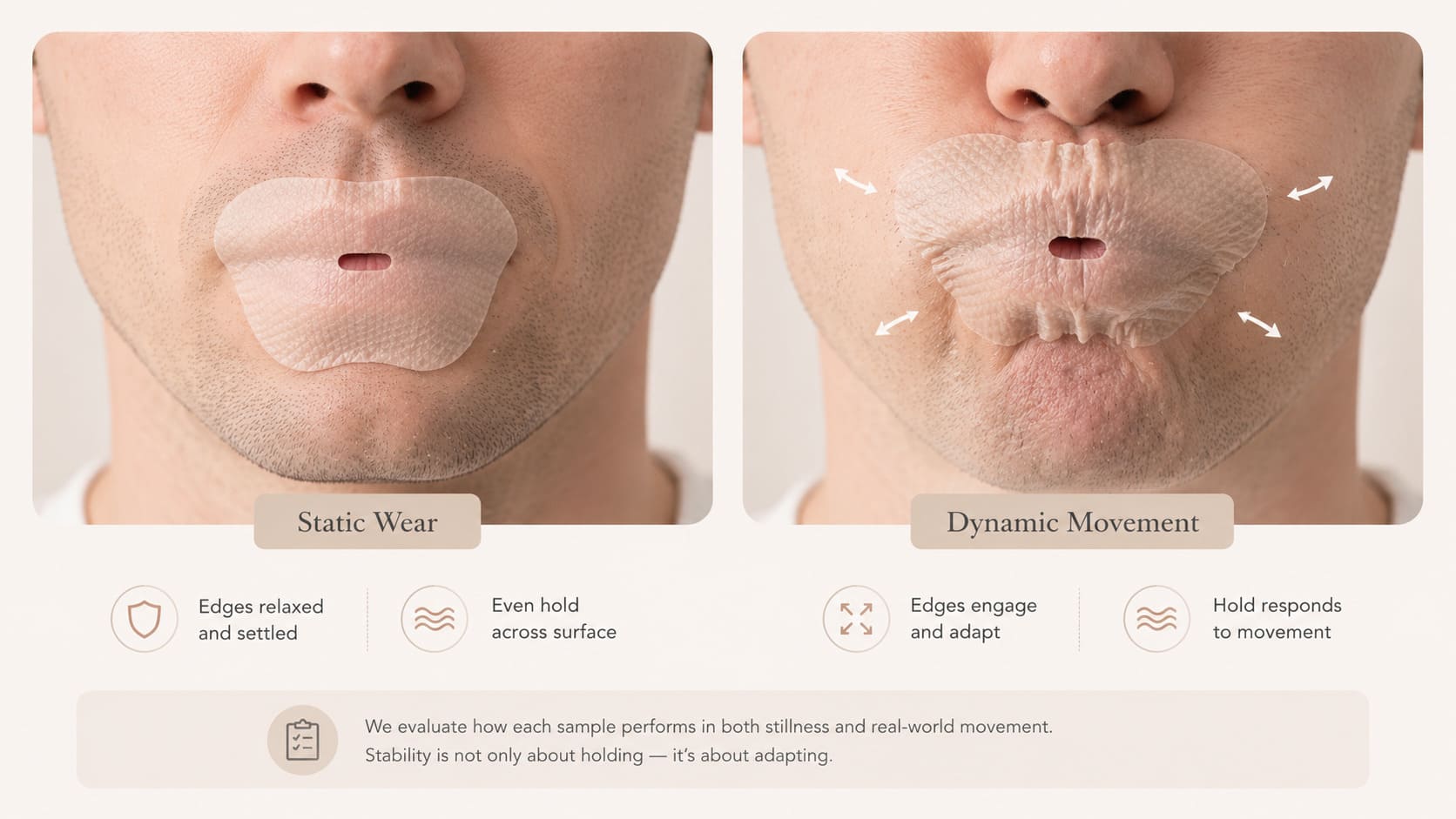
A mouth tape sample should be evaluated in both static wear and dynamic mouth movement.
Static wear means how the product behaves when the mouth is relaxed.
Dynamic movement means how the product behaves when the user makes small mouth movements, such as chewing, pouting, slight opening, or talking simulation.
A product can feel stable at rest but behave differently during movement.
- whether the center holds clearly
- whether the upper edge stays in place
- whether the lower edge stays in place
- whether the side edges feel secure
- whether there is obvious air-flow leakage
- whether the patch feels like it may fall off
- whether the first application feels acceptable
- which edge releases first
- whether the release feels normal or unstable
- whether the perimeter collapses
- whether the center remains stable
- whether the patch pulls inward
- whether the user feels too restricted
- whether the mouth can move slightly
A low-pressure route may have softer dynamic edge behavior. A strong-hold route should keep the perimeter more controlled.
Center Hold vs
Perimeter Hold
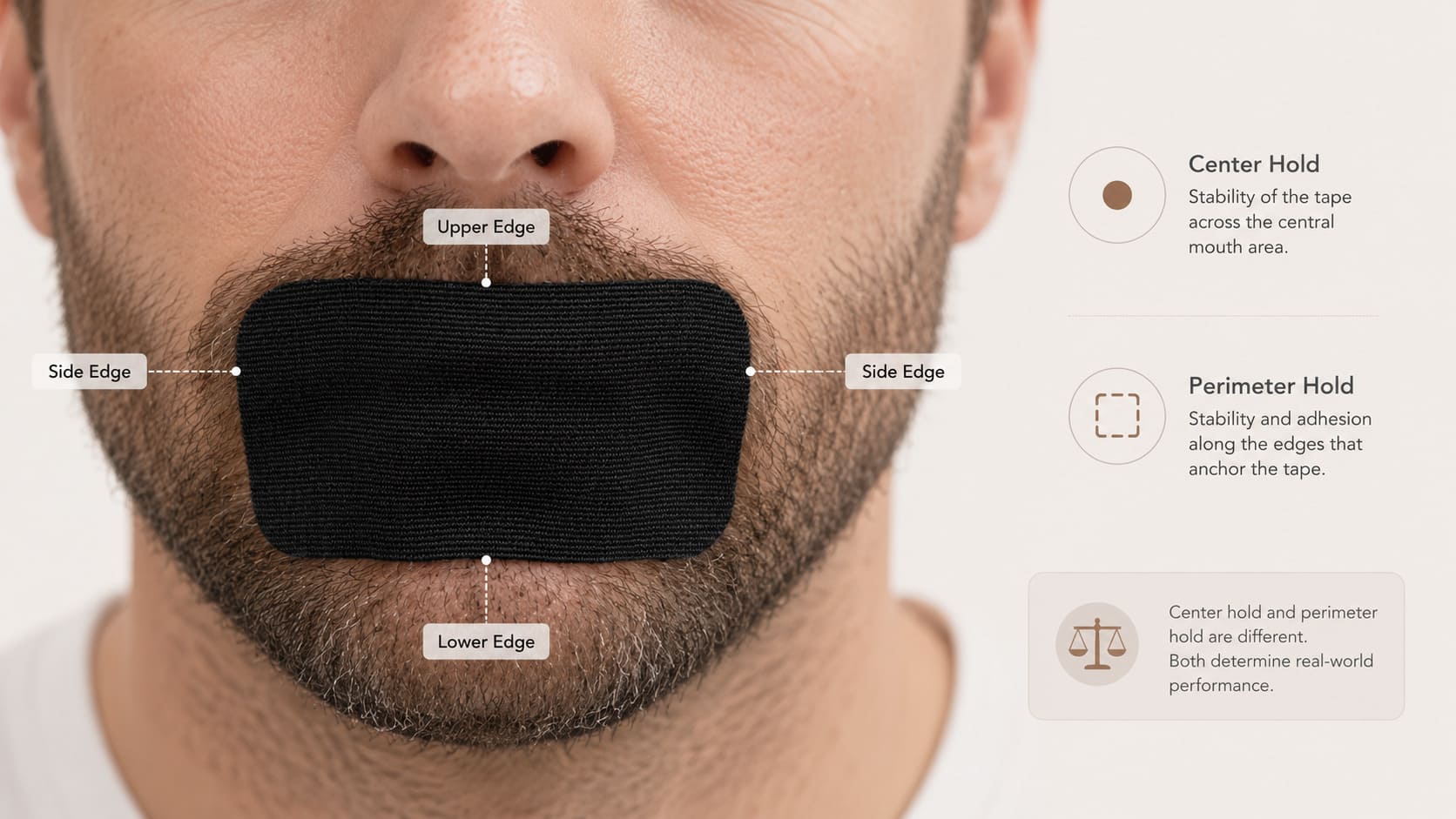
Center hold and perimeter hold are different. Some products feel stable at the center but softer at the edges. Some products feel stronger around the perimeter but freer in the center. Some products use a dual-zone structure, where lip-area behavior and perimeter behavior are separated.
This distinction is important because buyers often say "the tape holds well" or "the tape feels loose," but those comments may refer to different parts of the patch.
How stable the central mouth area feels. Matters for full-coverage products, lip-area adhesion, and psychological security.
How the upper, lower, and side edges behave. Matters for edge release, dynamic stability, and full coverage vs open-center comparison.
| Observation | Possible Route Meaning |
|---|---|
| Stable center, softer edges | Low-pressure full-coverage route |
| Strong perimeter, controlled edges | Strong-hold route |
| Strong perimeter with optional lip behavior | Dual-zone route |
| Freer center, stronger upper/lower bands | Open-center route |
| Center loosens but perimeter remains firm | Skin-patch or silicone route behavior |
Understanding center vs perimeter behavior helps buyers avoid simple "good / bad" judgments.
Fit, Presence, Stability,
and Freedom
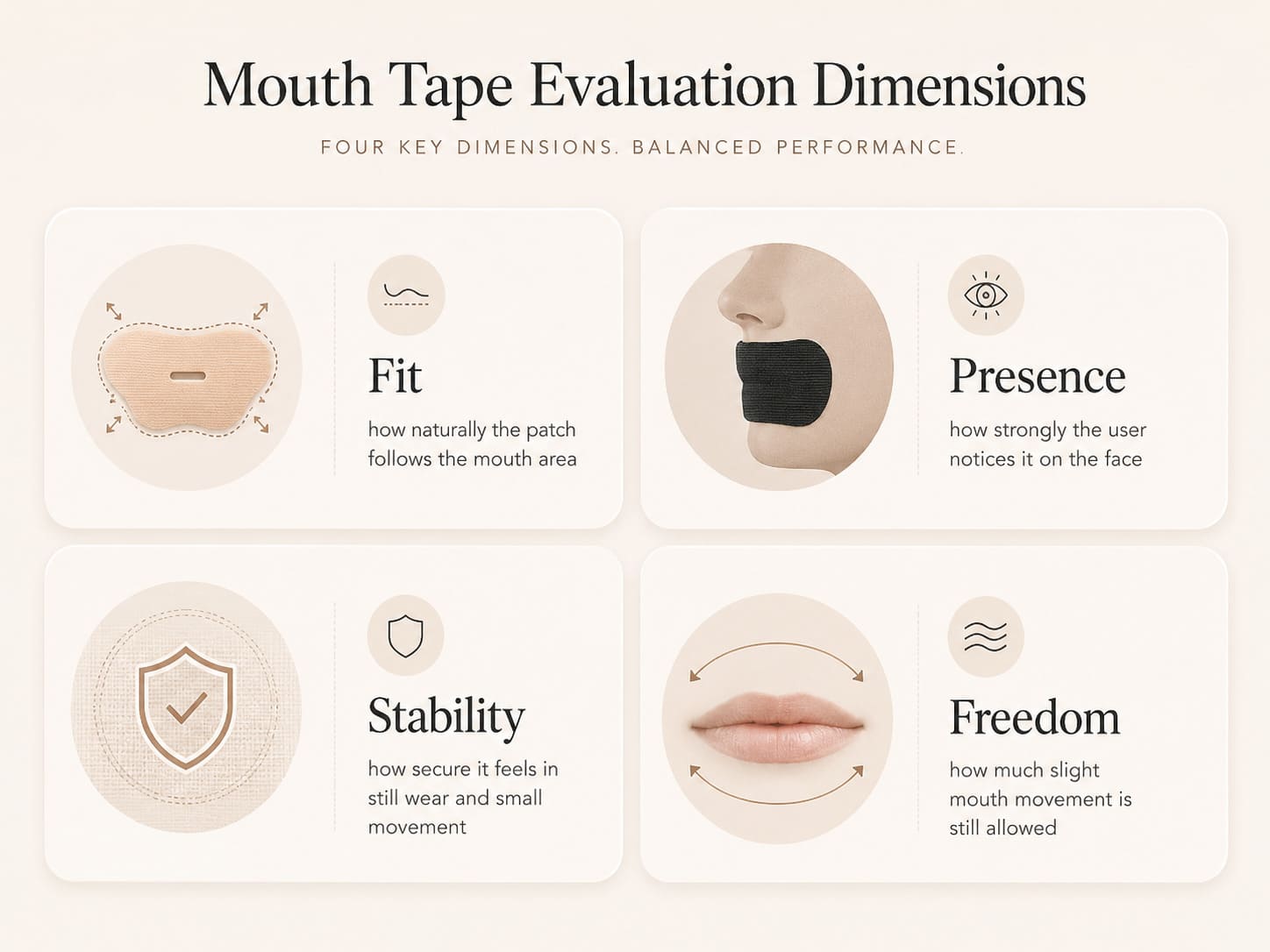
These four dimensions are central to mouth tape evaluation. They are related, but they are not the same.
Fit
Fit describes how well the patch follows the mouth area and surrounding skin. A good fit does not always mean the product feels strong -- it means the product sits naturally enough for its intended route.
Fit can be affected by shape, contour, size, backing flexibility, adhesive distribution, skin-contact area, and mouth movement.
A lip-shaped contour may improve natural fit. A larger full-coverage route may improve security but increase presence.
Presence
Presence means how strongly the user notices the patch on the face. It is not only about size -- it can be affected by thickness, material stiffness, adhesive pull, contour, color, edge feel, coverage area, and psychological pressure.
Low presence supports first-time users and premium wellness. Higher presence may be acceptable for strong-hold routes.
Stability
Stability describes whether the patch feels secure during still wear and small movements. It can come from perimeter grip, coverage area, adhesive behavior, shape, opening design, edge geometry, and material structure.
Strong stability suits secure-hold positioning. Moderate stability with softer edges suits low-pressure positioning.
Freedom
Freedom describes how much the user can slightly move the lips or mouth without feeling harsh resistance. Higher freedom may feel more natural but can reduce security. Lower freedom may feel more secure but can increase psychological pressure.
First-time acceptance, open-center routes, low-pressure routes, and strong-hold trade-offs.
Edge Behavior
and Airflow
Edge behavior is one of the most important parts of mouth tape testing. Many supplier descriptions focus on material and adhesive, but edge behavior often decides the real wearing feel.
A product may feel secure in still wear but release earlier during movement. Another product may feel more controlled because the upper and lower edges remain firm.
| Edge Observation | Possible Route Meaning |
|---|---|
| Soft edge release during movement | Low-pressure route |
| Strong edge hold with less release | Strong-hold route |
| Upper/lower bands stay firm | Open-center route |
| Corners loosen earlier | Low-presence contour route |
| Perimeter feels sealed | Secure or control-led route |
| Edge feels aggressive | May increase psychological pressure |
Airflow and
Lip Dryness
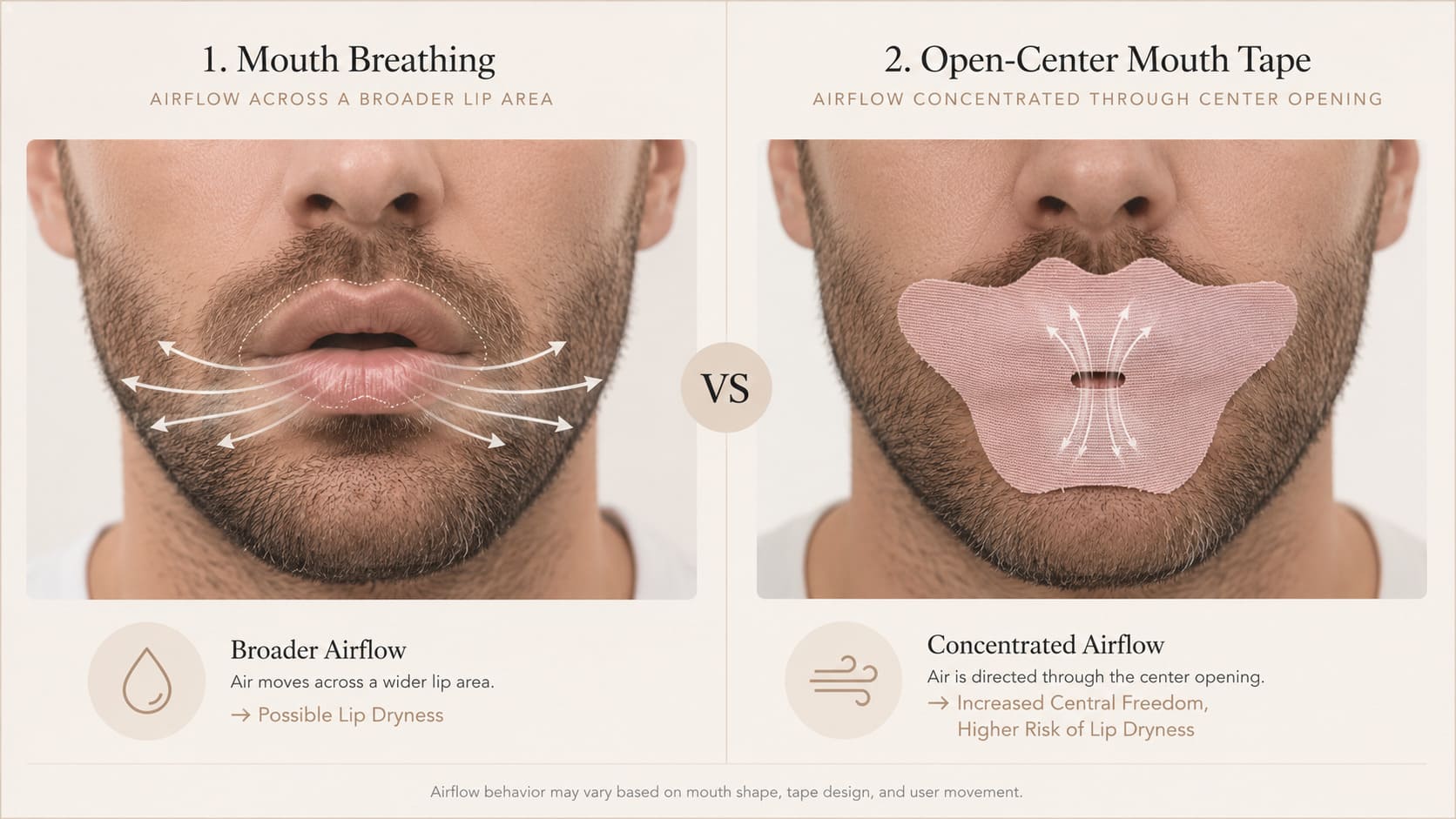
Airflow is especially important for open-center mouth tape. Open-center designs may increase central mouth freedom, but they can also concentrate airflow through the exposed center opening.
Without mouth tape, when the mouth opens during inhalation, air can pass across a broader mouth area. With open-center mouth tape, the surrounding lip area is held by the patch, and airflow is guided through a smaller exposed opening.
This can make lip dryness more noticeable.
- Does the user feel lip dryness after several minutes?
- Does the dryness increase with larger openings?
- Does the user feel air focused through the center?
- Do upper/lower bands feel more present?
- Is the dryness acceptable for the target user group?
Open-center should not automatically be positioned as more comfortable. A more accurate message is: open-center can increase central mouth freedom, but may increase lip dryness through airflow concentration.
Removal Comfort and
Beard-Friendliness
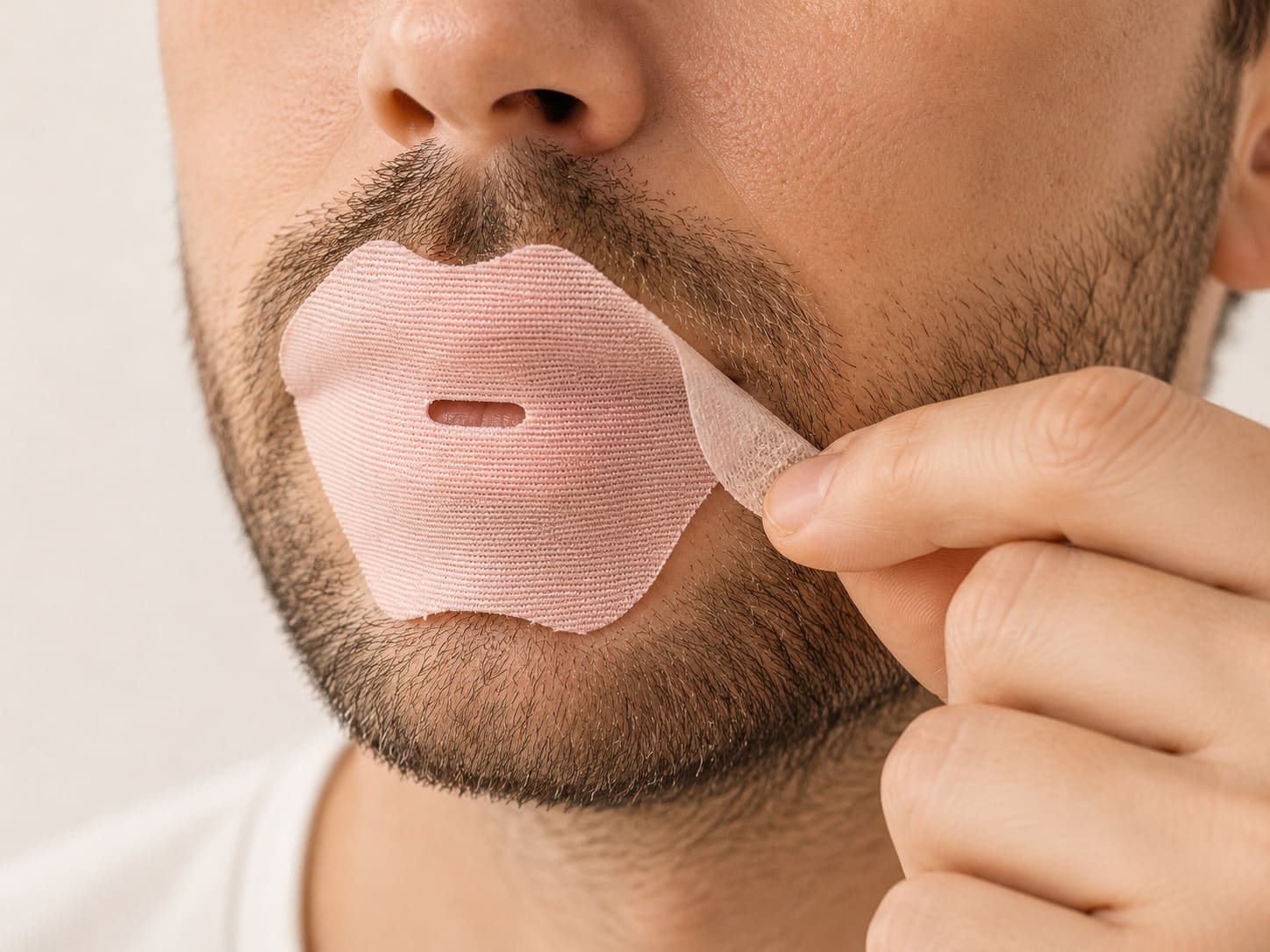
Removal comfort is critical for repeat-use products. A mouth tape may hold well, but if users dislike removing it, they may not use it again.
- gentle peel-off
- dry tearing sensation
- sticky pulling
- beard pull
- skin feeling after removal
- residue feeling
- hydrated release
- user willingness to apply again
- does the patch pull facial hair?
- does removal feel harsh or gentle?
- does the user feel immediate discomfort?
- does skin feel calm after removal?
- does the route support repeat use?
| Removal Observation | Route Meaning |
|---|---|
| Hydrated release | Gentle removal / silicone route |
| Low beard pull | Beard-friendly direction |
| Dry tearing sensation | May reduce repeat-use acceptance |
| Strong pulling | Better for secure hold only if buyer accepts trade-off |
| Clean removal | Supports premium comfort positioning |
Removal comfort should be tested separately from hold. A product can hold well and still remove gently. A product can look light but remove harshly.
Material Name vs
Real Feel
Material names are useful, but they are only the beginning. Cotton, rayon, silicone, non-woven, hydrogel, and film-based routes can all behave differently depending on structure.
Can feel relaxed if thin and low-pressure. Can also feel controlled if adhesive layout creates inward pulling.
Can feel smoother and more refined. Can also feel denser, more present, and more secure in a full-coverage format.
Can remove gently, but may feel thicker during wear. Route behavior depends on structure, not material name alone.
"This is why sample evaluation should focus on real mouth feel, not material label alone."
Route Fit: How We
Classify Samples
After observing the sample, the next step is route classification. We do not classify samples only by material or shape -- we classify by what the sample is best suited for.
| Route Fit | Key Behavior |
|---|---|
| Low-Pressure Route | Lower presence, softer edge behavior, easier acceptance |
| Balanced Hold Route | Practical middle ground between hold, freedom, and acceptance |
| Strong Hold Route | Stronger perimeter control, more secure feel, lower freedom |
| Gentle Removal Route | Better removal comfort, lower pulling, beard-friendly direction |
| Open-Center Route | More central freedom, airflow trade-off, possible lip dryness |
| Natural / Low-Presence Route | Reduced unnecessary coverage, softer psychological feel |
| Secure Full-Coverage Route | Strong wrap, high stability, higher presence |
| Silicone Skin-Patch Route | Hydrated removal, thicker skin-patch feel |
Evaluation
Dimension Table
A structured reference for both internal evaluation and buyer sample comparison.
| Dimension | What We Observe | Buyer Meaning |
|---|---|---|
| First Application Feel | calm, restrictive, dry, hydrated, heavy | first-time acceptance |
| Static Hold | center, upper, lower, side edge | basic stability |
| Dynamic Movement | chewing, pouting, slight opening | movement tolerance |
| Center Hold | whether central mouth area stays controlled | full-coverage or lip-area behavior |
| Perimeter Hold | upper/lower/side edge stability | secure hold or edge release |
| Presence | low, medium, high | psychological burden |
| Freedom | mouth movement allowance | comfort vs control |
| Edge Behavior | release, lifting, collapse | route fit |
| Lip Dryness | airflow concentration | open-center trade-off |
| Removal Comfort | pulling, tearing, beard pull | repeat-use acceptance |
| Product Vibe | wellness, functional, skin-patch, premium | packaging fit |
This table is useful for both internal evaluation and buyer sample comparison.
Observation to
Route Meaning
This is how subjective wear observations become useful B2B route decisions.
| Observation | Route Meaning |
|---|---|
| Stable center, softer edges | Low-pressure full coverage |
| Strong perimeter, less edge release | Strong hold route |
| Higher freedom, lip dryness | Open-center route |
| Hydrated removal, low beard pull | Gentle removal route |
| Horizontal gathering | Controlled adhesive logic |
| Lower contour coverage | Low-presence / natural route |
| Larger footprint, stronger wrap | Secure full-coverage route |
| Thicker skin-like contact | Silicone skin-patch route |
| Small format but dry or firm | Compact does not automatically mean low-pressure |
| Smooth but dense material feel | Rayon route may support secure hold |
Sample Testing
Checklist
Use this checklist when evaluating mouth tape samples for private label route selection.
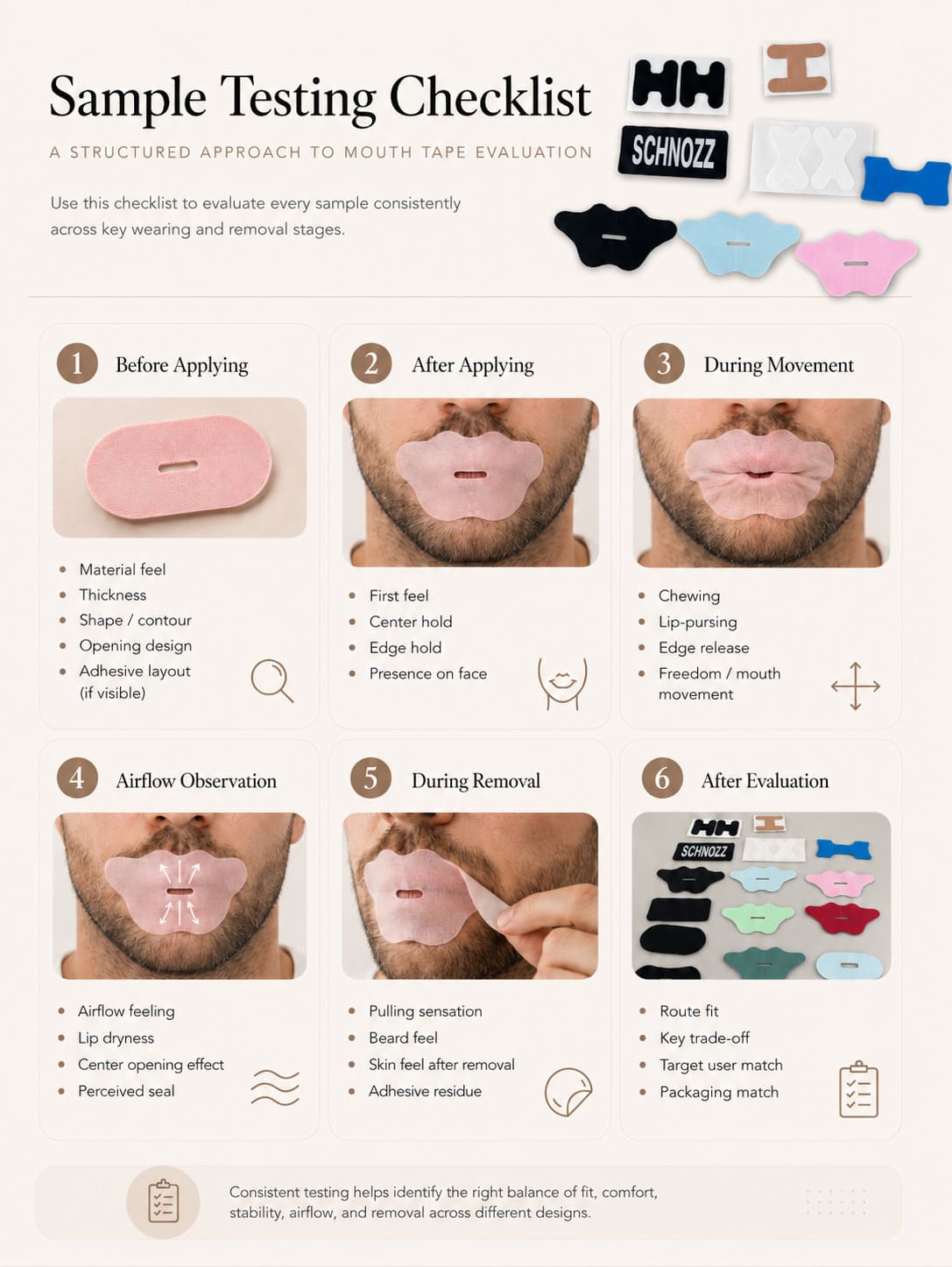
Before Applying
- What is the material feel?
- Is the surface smooth, fuzzy, dry, hydrated, or skin-like?
- Is the patch thin, thick, flexible, or firm?
- What is the shape?
- Is it full coverage or open-center?
- Is the adhesive layout visible?
- Does the shape look like it may create unnecessary coverage?
After Applying
- What is the first application feel?
- Does it feel calm or restrictive?
- Does the center hold clearly?
- Do the upper and lower edges stay in place?
- Does the patch feel low, medium, or high in presence?
- Does it feel like a sleep/wellness product or a functional adhesive patch?
During Movement
- What happens during chewing?
- What happens during lip-pursing?
- What happens during slight mouth opening?
- Which edge releases first?
- Does release feel normal or unstable?
- Does the patch pull inward?
- Does the user feel free or controlled?
Airflow Observation
- Does the product create air-flow feeling around the edges?
- Does an open-center design create lip dryness?
- Does opening size affect dryness?
- Does the user feel air concentrated through the center?
During Removal
- Does removal feel gentle or harsh?
- Is there dry tearing sensation?
- Is there sticky pulling?
- Is there beard pull?
- How does the skin feel after removal?
- Would the user apply it again?
After Evaluation
- Which route does this sample fit?
- Is it low-pressure, balanced, strong-hold, gentle-removal, or open-center?
- Is it suitable as a hero SKU or comparison sample?
- What trade-off must be explained?
- What packaging message would match this product?
Buyer Use
Matrix
This matrix helps buyers choose what to pay attention to during testing. Not every project needs the same sample focus.
| Buyer Goal | What to Focus On |
|---|---|
| First-time users | first feel, presence, psychological pressure |
| Strong hold | perimeter hold, dynamic edge behavior |
| Open-center | freedom, airflow, lip dryness |
| Gentle removal | peel-off feel, beard behavior |
| Premium wellness | product vibe, packaging fit |
| Hospitality | low barrier, simple use, gentle removal |
| Functional sleep product | secure hold, control, confidence |
| Material comparison | cotton vs rayon vs silicone feel |
| Packaging planning | product route and message fit |
| Private label sample kit | compare routes side by side |
How Buyers Should
Use This Method
Private label buyers can use this method in three stages.
Route Discovery
At this stage, the buyer does not yet know which product direction is best.
- compare low-pressure, balanced, strong-hold, and gentle-removal routes
- compare full coverage and open-center
- compare fabric and silicone routes
- avoid finalizing packaging too early
Route Confirmation
At this stage, the buyer has a preferred direction.
- test similar samples inside the same route
- compare material and adhesive behavior
- confirm trade-offs
- decide whether the product is a hero SKU or secondary SKU
Private Label Preparation
At this stage, the buyer is preparing for packaging and production.
- confirm final sample
- confirm packaging message
- confirm customization details
- confirm MOQ and lead time factors
- prepare bulk order discussion
Route Discovery
At this stage, the buyer does not yet know which product direction is best. Compare routes, coverage types, and materials before finalizing packaging.
Route Confirmation
The buyer has a preferred direction. Test within the same route, confirm trade-offs, and decide hero vs secondary SKU.
Private Label Preparation
Confirm sample, packaging message, customization, MOQ, and lead time. Prepare for bulk order discussion.
This method keeps the project practical. It helps avoid deep customization before the buyer understands the route.
How This Method Supports
Private Label Decisions
This evaluation method helps buyers make better decisions before bulk order. It can help answer:
This method is also useful for internal buyer teams.
It gives product managers, brand teams, and sourcing teams a shared language for evaluating mouth tape samples.
Source & Evidence Note
This page is based primarily on internal mouth tape sample evaluation for B2B private label product selection. Observations focus on wear behavior, not medical outcomes.
Request Route-Based
Sample Evaluation
If you are developing a private label mouth tape line, we can help you compare samples by route instead of sending one random sample.
Send us:
We can recommend a route-based sample kit and help you evaluate samples by fit, presence, stability, freedom, edge behavior, lip dryness, removal comfort, beard-friendliness, and private label route fit.
Ask Us to Recommend Samples by Route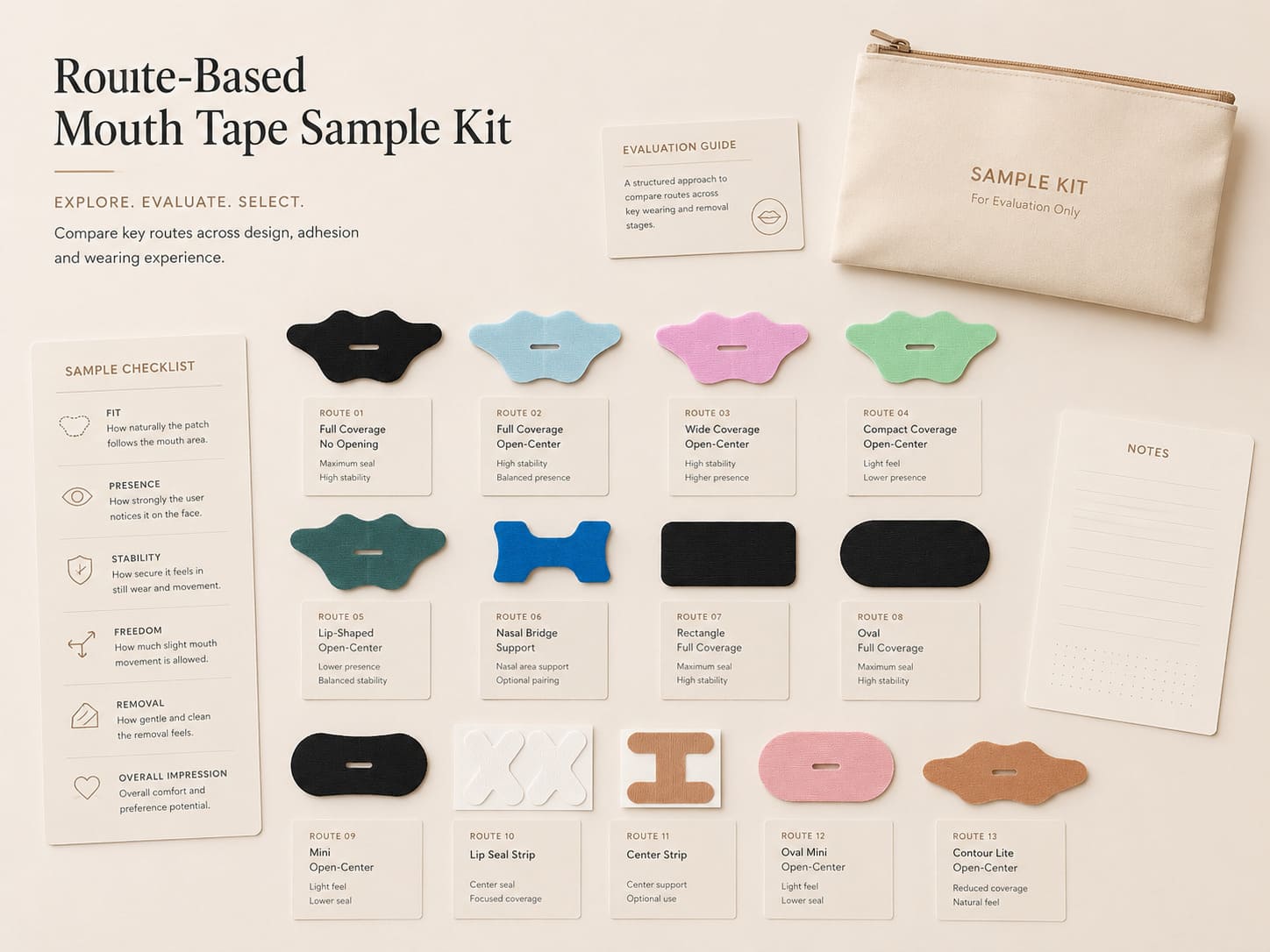
Related Pages
Frequently Asked
Questions
Is this a consumer mouth tape review system?
No. This is not a consumer ranking or review system. It is a B2B sample evaluation method used to support private label product route selection.
Why not just compare materials?
Material is only one part of the final experience. Adhesive layout, shape, size, thickness, opening design, edge behavior, and removal profile can all change how a mouth tape feels.
Why test static wear and dynamic movement separately?
A patch may feel stable when the mouth is relaxed but behave differently during chewing, pouting, or slight mouth movement. Both static and dynamic behavior matter.
What is the difference between center hold and perimeter hold?
Center hold describes how stable the central mouth area feels. Perimeter hold describes how the upper, lower, and side edges behave. Different product routes may prioritize these areas differently.
Why is presence important?
Presence describes how strongly the user notices the patch on the face. Lower presence can support first-time acceptance, while higher presence may be acceptable for strong-hold positioning.
Why is lip dryness tested?
Lip dryness is important for open-center designs. The exposed center opening can concentrate airflow over a smaller lip area, making dryness more noticeable.
Why is removal comfort important?
Removal comfort affects repeat-use acceptance. A product may hold well, but if it pulls skin or beard hair during removal, users may resist using it again.
How does this testing help private label buyers?
It helps buyers match product route, user fit, packaging message, and sample strategy before bulk production. This reduces the risk of choosing a product based only on appearance or supplier wording.
What is the best first step?
The best first step is to request a route-based sample kit and evaluate samples by wear behavior, not just material name or product photo.
Start with a route-based sample kit.