Full Coverage vs
Open-Center
Mouth Tape
A private label buyer guide to coverage, mouth freedom, airflow behavior, edge control, and route selection.
Full coverage and open-center mouth tape routes can create very different wearing experiences. For private label buyers, the right choice depends on target users, hold expectations, airflow behavior, perceived pressure, removal feel, and sample feedback.
Neither Route Is
Automatically Better
Full coverage provides a more unified patch format and can support low-pressure, balanced, or strong-hold routes depending on material, adhesive behavior, thickness, and footprint.
Open-center designs leave part of the lip area exposed. They may increase central mouth freedom, but they can also change airflow behavior, edge control, and lip dryness.
For private label buyers: The best route should be chosen through sample comparison, not by appearance alone. Both routes require testing before finalizing shape, adhesive, material, and packaging language.
Full Coverage Route
Full coverage creates a unified patch format across the mouth area. It can make the product feel more stable, more reassuring, and easier to understand for users who expect a complete mouth-covering format.
Supported Product Routes
Buyer-Focused Benefits
- Clearer coverage feeling
- Broader surface contact
- More unified patch structure
- Easier packaging explanation
- Flexible hold positioning
Potential Trade-Offs
- May feel more present if too large
- May increase psychological pressure for sensitive users
- May create more removal pull if adhesive is too strong
- Needs careful material, size, and adhesive selection
Full coverage is not automatically restrictive. A thin, relaxed, softer-edge full-coverage route can feel calmer than expected. The final experience depends on material, size, adhesive behavior, and edge design -- not the format alone.
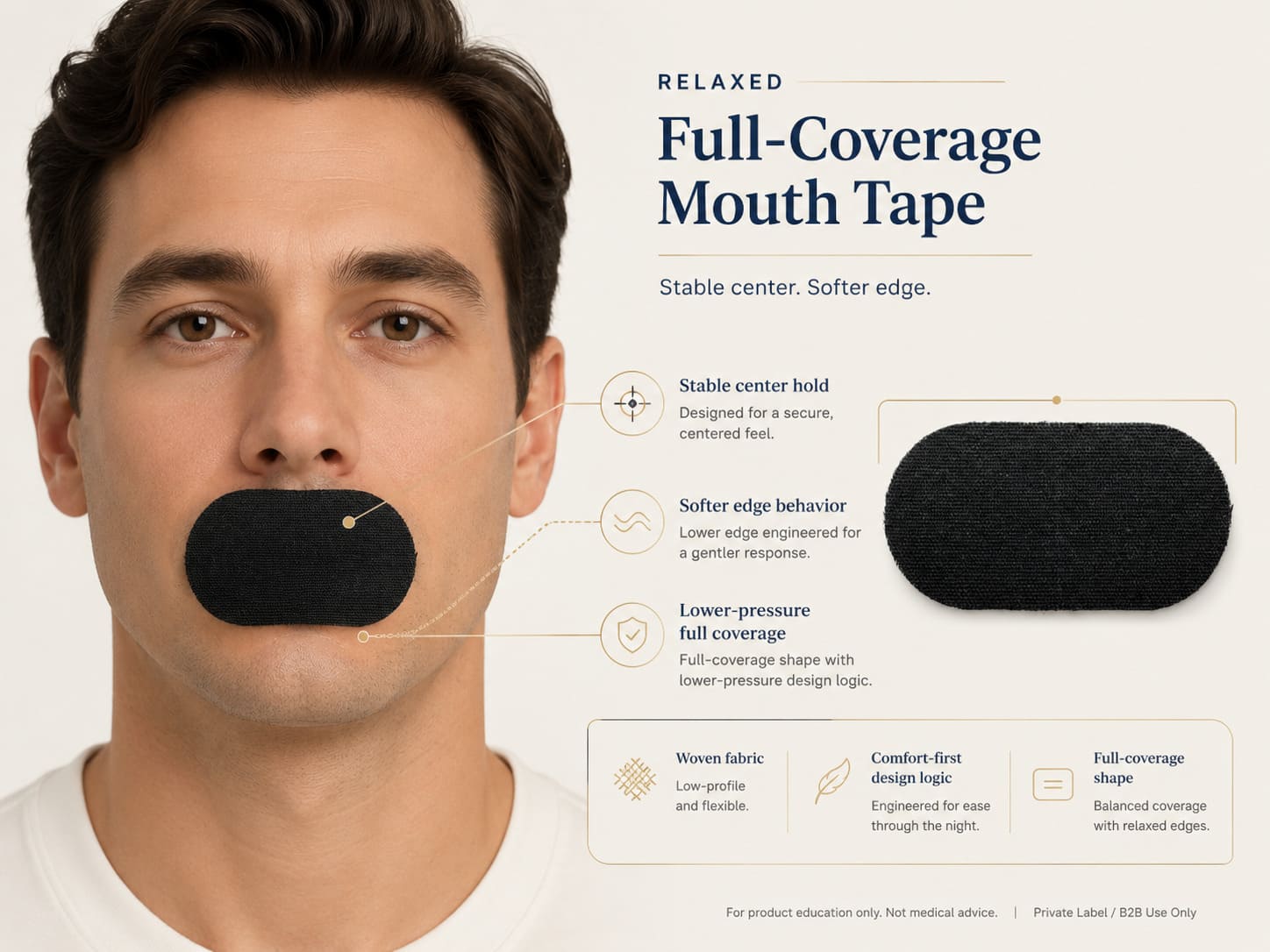
Route Visual Reference
Full-coverage wearing logic -- stable center hold, softer edge behavior, and controlled lower-pressure coverage. A relaxed full-coverage route can feel significantly calmer than buyers may expect.
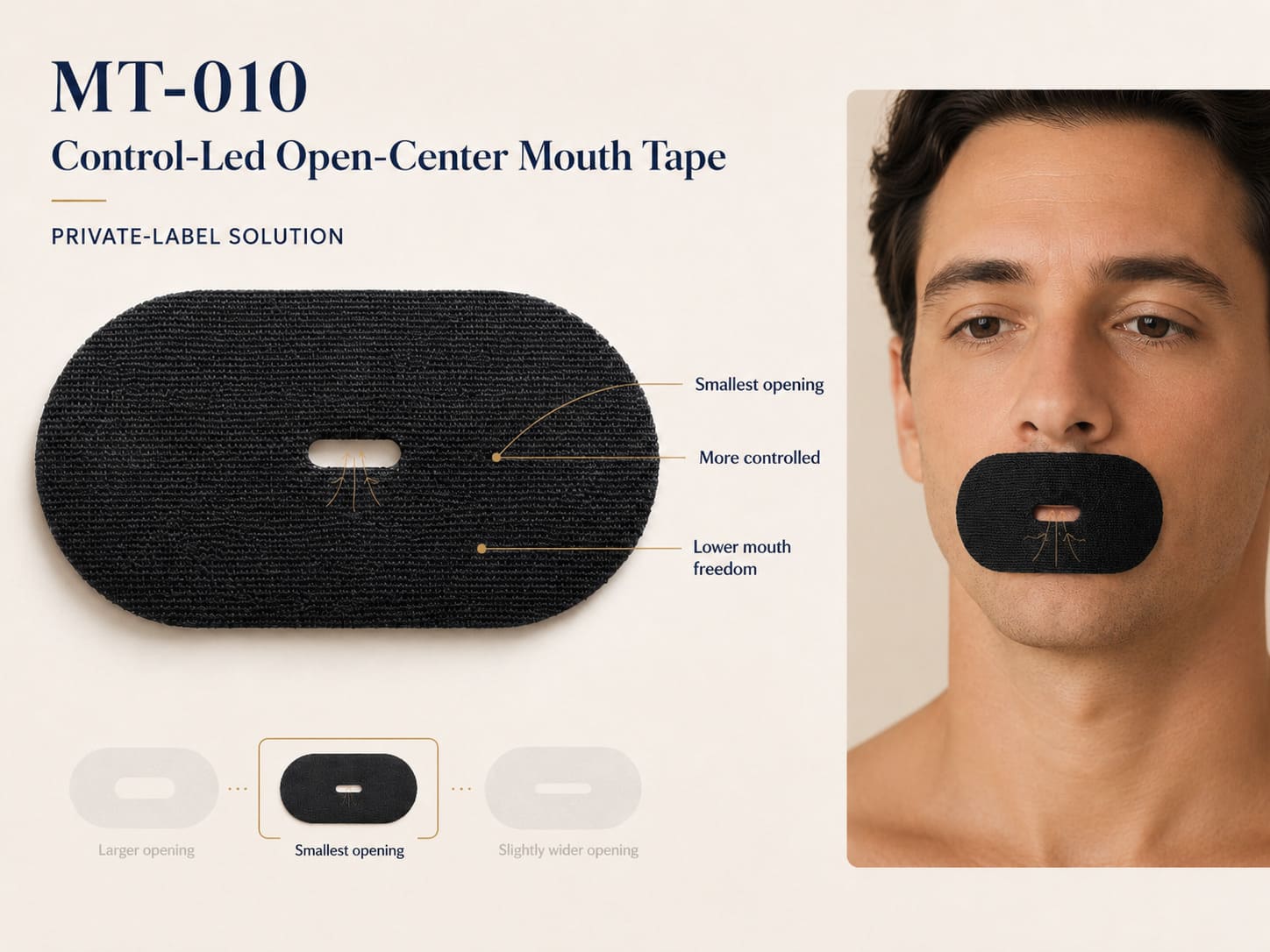
Route Visual Reference
Open-center route -- opening size, perimeter control, and edge behavior are critical. The central opening must be tested carefully to balance mouth freedom with airflow concentration and edge awareness.
Open-Center Route
Open-center mouth tape leaves part of the lip area exposed. This can reduce the feeling of full-mouth coverage and may increase central mouth freedom for some users.
Supported Product Directions
Buyer-Focused Benefits
- Reduces full-mouth coverage feeling
- May increase central mouth freedom
- Creates differentiated product story
- Useful for habit-building positioning
Potential Trade-Offs
- Larger opening may increase airflow concentration
- Lip dryness may become more noticeable
- Edge awareness can increase
- Perimeter control becomes more critical
- Opening size must be tested carefully
Open-center does not automatically mean more comfortable. The final feel depends on opening size, edge behavior, adhesive layout, material route, and target user expectations. Opening size must be confirmed through sample testing -- not assumed from appearance.
Route Comparison
Decision Matrix
A quick-reference guide for B2B buyers evaluating full-coverage and open-center routes across the key decision areas.
| Decision Area | Full Coverage Route | Open-Center Route |
|---|---|---|
| Main Idea | Unified coverage across the mouth area | Central opening with exposed lip area |
| User Perception | More complete, stable, controlled, reassuring | More open, freer, more differentiated |
| Hold Logic | Broader surface contact and overall patch stability | Perimeter control and opening-edge stability |
| Mouth Freedom | Depends on material, size, and adhesive route | Usually higher at the center |
| Airflow Behavior | Less concentrated through a central opening | Airflow may become more concentrated |
| Lip Dryness Risk | May be lower when lips are covered | May increase depending on opening size |
| Presence | Can feel calm or present depending on route | Can feel freer but may create edge awareness |
| Best For | Low-pressure Balanced Strong-hold routes | Freedom-led Open-center Differentiated routes |
| Testing Focus | Presence, hold, removal pull, comfort | Opening size, edge control, airflow, dryness |
Airflow and Lip Dryness Are
Important Trade-Offs
Many buyers assume open-center designs are always more breathable. But the real experience is more nuanced.
An opening can create a more concentrated airflow path. This may increase mouth freedom, but it may also make lip dryness more noticeable for some users.
Full coverage may feel less open, but it may also avoid concentrated airflow through a central opening.
The relationship between opening size and perceived breathability is not linear. Buyers should test both routes under real wear conditions before drawing conclusions from appearance alone.
Buyer Testing Should Include
Perceived Breathability
Does the user feel the product is breathable enough for overnight wear?
Lip Dryness
Does dryness become noticeable after extended wear? Compare both routes.
Central Mouth Freedom
Does the opening feel natural or does it create edge awareness?
Opening Size Naturalness
Does the size feel appropriate for the target user's mouth and comfort level?
Repeat-Use Acceptance
Does the user still accept the product after 3-5 nights of repeated use?
Edge Control During
Mouth Movement
Mouth tape should be evaluated during small mouth movements, not only when the mouth is still. A product that looks good on a table may behave differently around the mouth.
Light Talking Movement
Lip-Pursing
Small Chewing Motion
Facial Expression Changes
Side Tension
Edge Lifting
Full coverage usually depends on overall footprint and edge stability. A well-designed footprint with appropriate adhesive behavior can maintain position through light movement without creating excessive pull.
Open-center designs depend more heavily on perimeter control and opening-edge behavior. The edge around the opening is a critical zone -- it must maintain adhesion while the central area moves freely.
Which Route Should a
Buyer Test First?
Match your brand positioning and target user profile to the most relevant starting route.
First-Time User Acceptance
Target users who are new to mouth tape or have lower pressure tolerance.
Suggested Direction
Relaxed full-coverage or lower-presence route
Stronger Security Feeling
Users who prioritize hold confidence and reliable overnight adhesion.
Suggested Direction
Full-coverage route with stronger edge control
More Central Mouth Freedom
Users who want reduced full-mouth coverage and prefer an open feel.
Suggested Direction
Open-center route with tested opening size
Lower Lip Dryness Concern
Users who are sensitive to lip dryness and need careful route comparison.
Suggested Direction
Compare full coverage with smaller-opening open-center samples
Differentiated Product Story
Brands that want a distinctive product format with a clear visual difference.
Suggested Direction
Open-center or dual-zone route
Broad Retail Fit
Brands targeting a wide consumer base without a narrow niche positioning.
Suggested Direction
Balanced hold route and route-based sample comparison
Low-Pressure Positioning
Brands emphasizing gentleness, calm, and minimal-feel product experience.
Suggested Direction
Relaxed full coverage, lighter contour, or softer adhesive route
Functional Secure-Hold Line
Performance-oriented brands where reliable hold is the primary message.
Suggested Direction
Stronger full-coverage route with clear usage guidance
What to Test Before Choosing
Full Coverage or Open-Center
Route selection should be based on real sample testing, not visual assumptions. Use this checklist when evaluating samples from both routes.
Request Route Comparison SamplesDoes the patch feel stable or too present during wear?
Does the opening size feel natural? (open-center)
Does airflow feel comfortable or too concentrated?
Does lip dryness become noticeable after extended wear?
Does the edge lift during small mouth movements?
Does removal feel acceptable without excessive pull?
Does the shape match the intended packaging story?
Does the target user prefer the route after real sample testing?
From Route Choice to
Private Label Product
For private label buyers, route choice should come before customization. Do not start by changing opening size or shape without first understanding the target product route.
-
1
Define Target Users
Establish user profile, comfort expectations, and hold preferences before route selection.
-
2
Compare Full-Coverage and Open-Center Routes
Request samples from both route types before narrowing down direction.
-
3
Test Hold, Mouth Freedom, Airflow, Dryness, and Removal
Use the sample testing checklist across all key performance dimensions.
-
4
Collect Sample Feedback
Gather structured feedback from representative users before finalizing direction.
-
5
Adjust Shape, Opening Size, Adhesive, Material, or Packaging
Refine based on sample feedback, not assumptions from appearance.
-
6
Confirm Sample Before Bulk Production
Final sample sign-off should precede any bulk order commitment.
Continue Your Route Research
Frequently Asked
Buyer Questions
Common questions from private label buyers comparing full-coverage and open-center mouth tape routes.
Request Full Coverage and
Open-Center Samples
Tell us your target users, comfort and security priority, mouth freedom expectations, airflow concerns, and packaging direction. We can help you compare full-coverage and open-center mouth tape samples before customization and bulk production.