Low Pressure vs
Strong Hold
Mouth Tape
A private label buyer guide to pressure, hold, presence, removal feel, and route selection.
Low-pressure and strong-hold mouth tape routes serve different buyer goals. One may prioritize lower presence and first-use acceptance, while the other may prioritize stronger security and control. For private label buyers, the right choice depends on target users, sample feedback, packaging direction, and route positioning.
Low Pressure and Strong Hold
Solve Different Problems
Usually designed for lower presence, easier acceptance, softer edge behavior, and comfort-led positioning.
Neither route is automatically better. The right route depends on buyer goal, target users, product story, and real sample testing.
Usually designed for stronger security, more controlled hold, and higher reassurance for users who want a firmer product feel.
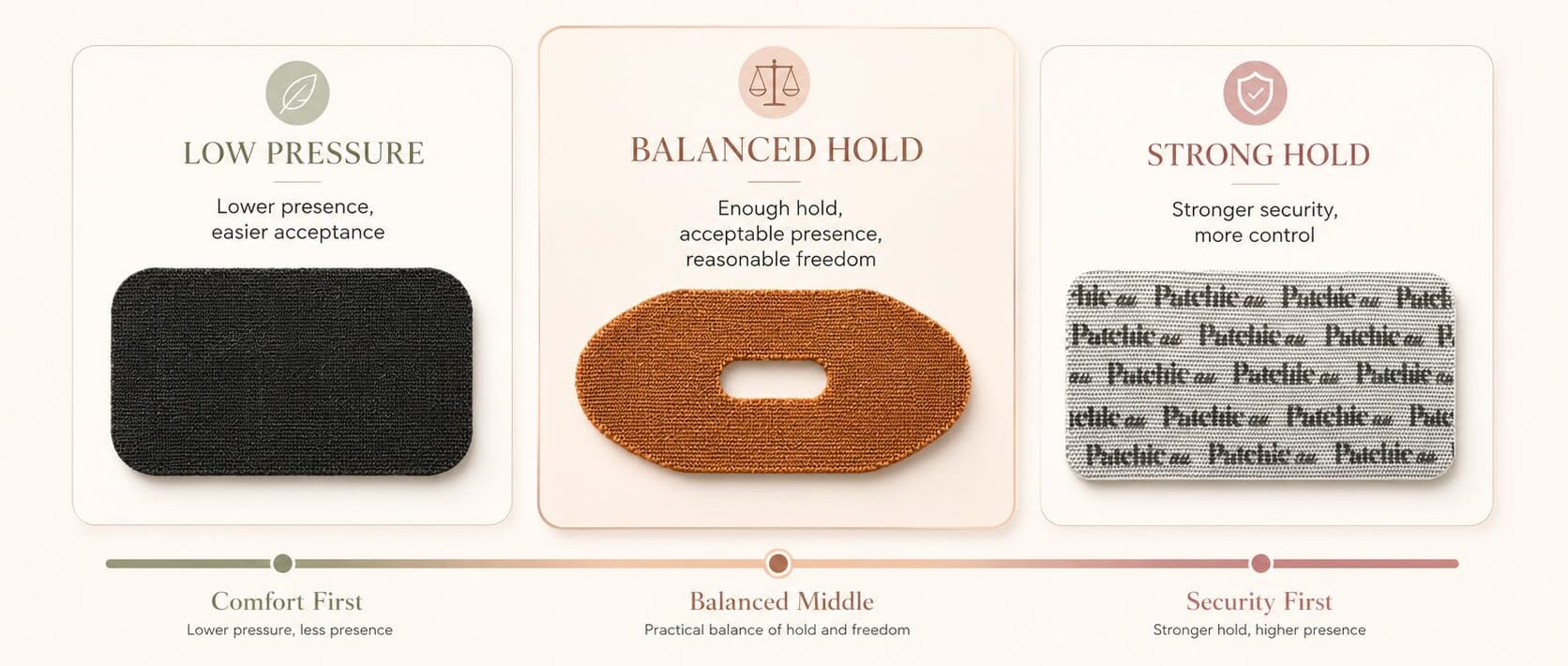
Low Pressure, Balanced Hold, and Strong Hold
Are a Route Spectrum
Private label buyers should not think only in two extremes. Most mouth tape products sit somewhere across a route spectrum with three primary directions.
May fit starter-friendly products and broad user adoption positioning.
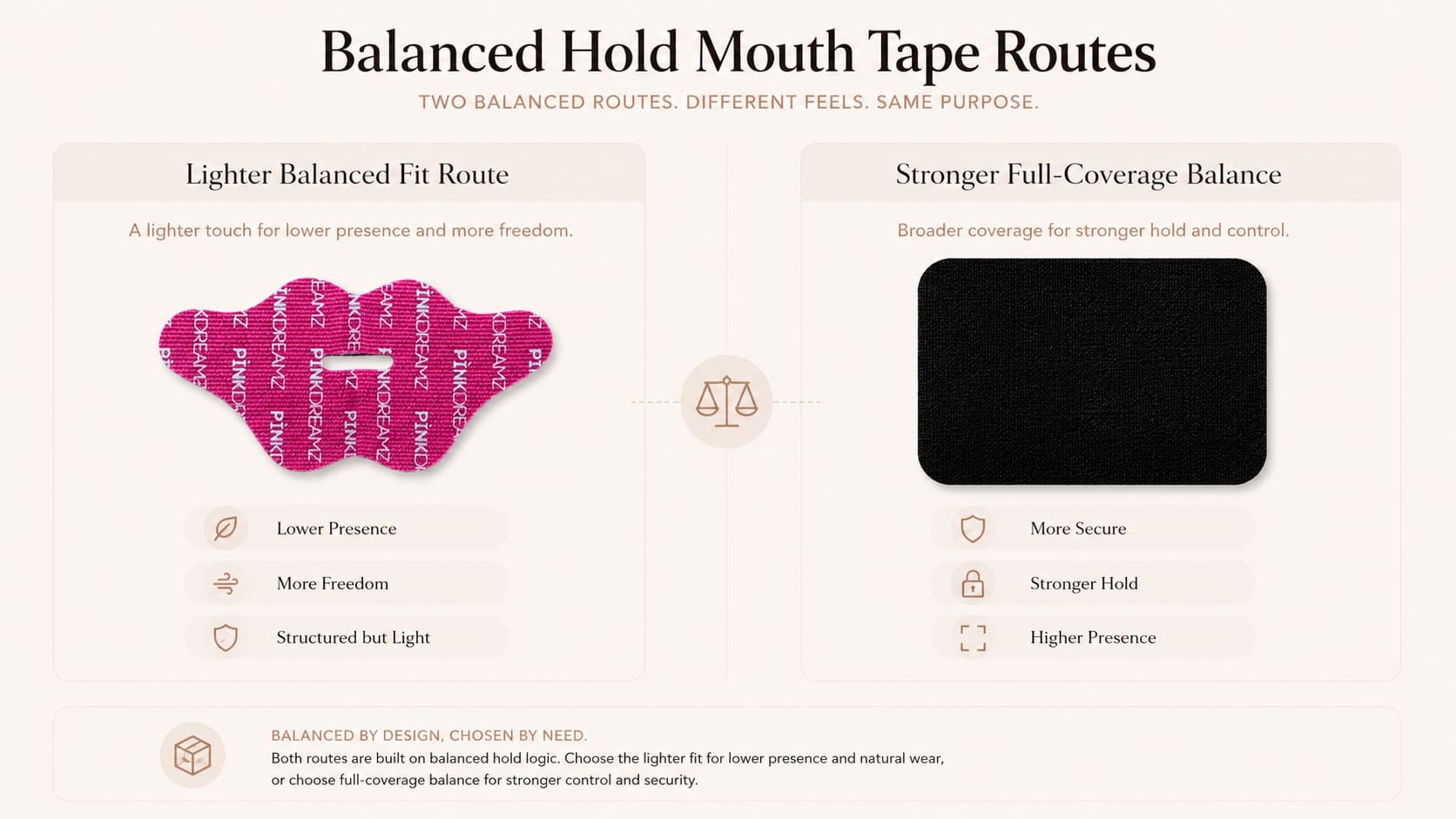
Useful when the buyer wants enough hold, acceptable presence, and reasonable user freedom. Often the right starting point for broad retail or first SKU planning.
May fit more security-led products and experienced user markets.
Low Pressure Route
Low pressure does not mean the product has no hold. A low-pressure route is designed to reduce perceived presence, restriction, and psychological pressure while still providing reasonable stability for the intended use.
Low pressure should be tested by how the product feels on the mouth, not only by adhesive strength.
- ·Lower presence
- ·Easier first-use acceptance
- ·Softer edge behavior
- ·Comfort-led positioning
- ·Suitable for starter kits
- ·May not feel secure for users wanting stronger control
- ·Needs careful edge design to avoid early lifting
- ·Packaging language must distinguish from weak hold
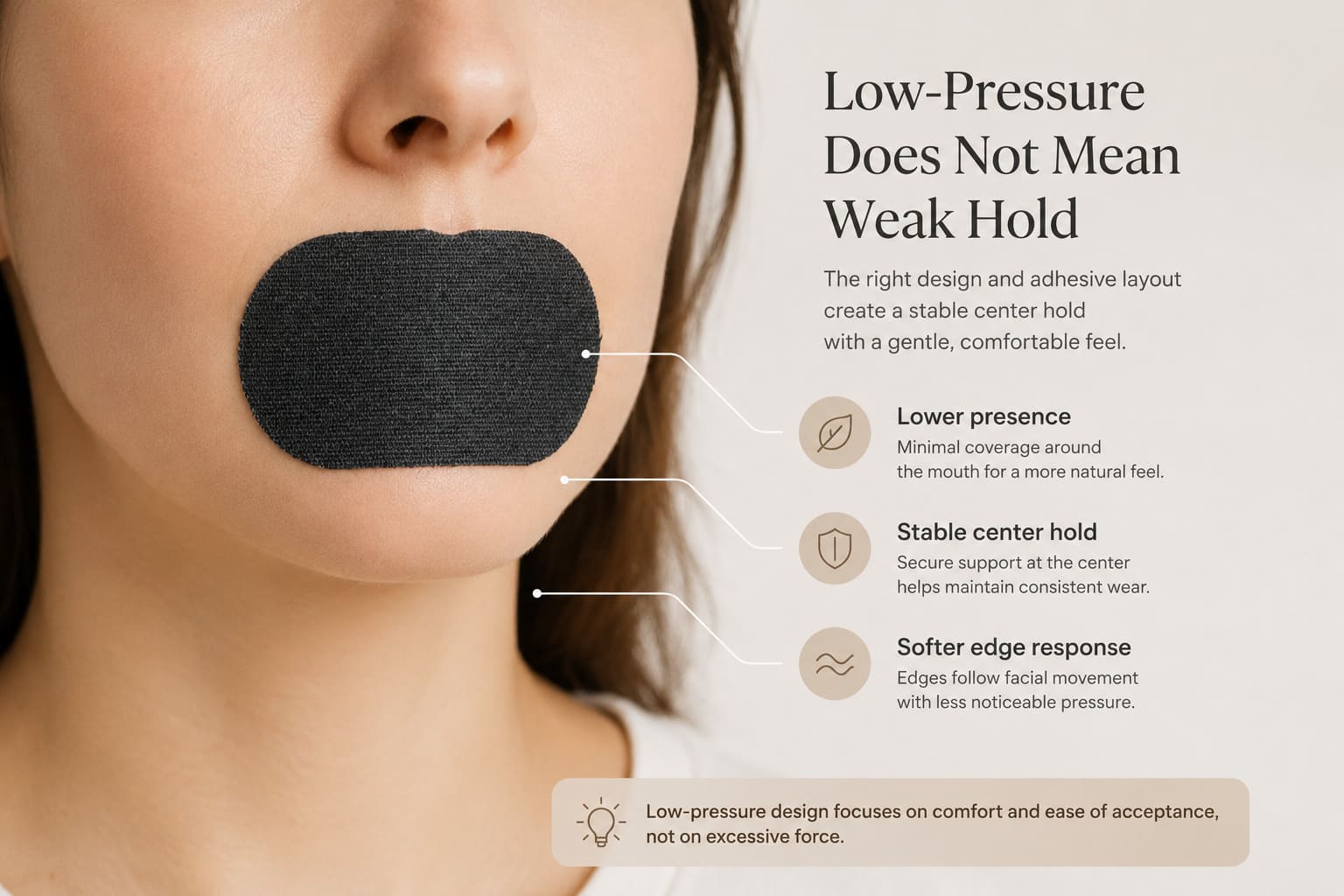
"Low pressure can still provide stable center hold and acceptable wearing behavior -- the route is about perceived feel, not absence of hold."
Strong Hold Route
"Strong hold does not have to feel harsh, but it needs careful material, adhesive, and removal design."
Strong Hold Route
Strong hold is designed for buyers who want a more secure, more controlled, and more reassuring mouth tape direction. A strong-hold route may use larger footprint, stronger edge control, more structured material feel, and clearer functional packaging language.
- ·Stronger security feeling
- ·More controlled hold
- ·Higher reassurance for experienced users
- ·Supports functional positioning
- ·Suitable for secure-hold product lines
- ·May feel more present on the face
- ·May increase removal pull
- ·Less suitable for first-time or sensitive users
- ·Beard-friendliness needs careful testing
Low Pressure vs Strong Hold:
Side-by-Side
A practical decision matrix for private label buyers evaluating both routes.
| Decision Area | Low Pressure Route | Strong Hold Route |
|---|---|---|
| Main goal | Lower presence and easier acceptance | Stronger security and control |
| Typical user | First-time users, sensitive users, starter kits | Experienced users, secure-hold buyers |
| Wearing feel | Lighter, calmer, less present | More controlled, more reassuring |
| Hold logic | Enough hold with softer pressure | Stronger hold and edge control |
| Patch presence | Lower perceived presence | Higher perceived presence |
| Removal feel | Usually softer if designed well | Needs careful release testing |
| Packaging story | Comfort-led, starter-friendly, low-pressure | Secure, controlled, stronger hold |
| Risk | May feel too light for some users | May feel too strong for sensitive users |
| Best tested by | Presence, edge behavior, acceptance | Hold, removal pull, beard concerns |
Pressure and Presence
Are Not the Same as Hold
Buyers often mix three different ideas that should be evaluated separately during sample testing.
A product can have reasonable hold but low presence. A product can feel strong but still have acceptable removal. A product can look light but feel present if the material or adhesive is too dry or direct. This is why sample testing matters.
Request Route Comparison SamplesWhether the product stays in place during wear. Measured by edge lift, center stability, and movement response.
How much control or pulling the user feels. A strong hold can be designed with low perceived pressure.
How noticeable the product feels on the face. Can be influenced by material, shape, and adhesive behavior independently of hold strength.
Hold, Edge Behavior, and Removal Feel
Must Be Tested Together
A strong hold may work well during wear but create problems during removal. A low-pressure product may feel comfortable but still needs stable edge behavior. Private label buyers should test all dimensions before confirming a route.
- · Center hold stability
- · Edge lift behavior
- · Small mouth movement response
- · Removal pull feeling
- · Beard pull behavior
- · Residue after removal
- · First-use comfort response
- · Next-night acceptance
- · Repeat-use willingness
- · Matches packaging story
- · Fits target user profile
- · Aligns with brand direction
The best product route balances hold, comfort, and repeat-use acceptance -- not just adhesive strength.
Which Route Should a
Buyer Test First?
Select the buyer goal that best matches your product direction to find the suggested starting route.
First-Time User Acceptance
Low-pressure or relaxed full-coverage route.
Broad Retail First SKU
Balanced hold route.
Stronger Security Feeling
Strong-hold full-coverage route.
Sensitive User Positioning
Lower-presence route with softer edge behavior.
Beard-Friendly Use
Test removal profile and consider gentle-removal routes.
Premium Secure Product Line
Smoother material, stronger hold, controlled packaging language.
Hospitality or Trial Kit
Low-pressure or balanced hold route with clear instruction card.
Experienced User Market
Stronger hold route with sample-confirmed removal behavior.
What to Test Before Choosing
Low Pressure or Strong Hold
Use this checklist when evaluating route-based samples before confirming customization direction and bulk production.
- Does the product feel too light or too present?
- Does the hold feel secure enough for the target user?
- Does the edge lift during small mouth movement?
- Does removal feel acceptable?
- Does the adhesive pull facial hair?
- Does the product leave residue?
- Does the route match the intended packaging story?
- Does the target user want to use it again?
From Route Choice to
Private Label Product
Route choice should come before customization. Do not start by changing adhesive strength without knowing the target product route.
Define Target Users
Understand who will use the product and what they expect from hold, presence, and comfort.
Choose Route Direction
Select low-pressure, balanced hold, or strong-hold direction based on buyer goal and user profile.
Compare Route Samples
Test pressure, hold, presence, removal, and edge behavior across route-based samples.
Collect Sample Feedback
Gather real user feedback before adjusting shape, material, adhesive, color, or packaging.
Adjust Customization
Refine shape, material, adhesive, color, and packaging based on sample feedback and route fit.
Confirm Before Bulk
Confirm final sample before bulk production. Packaging language should reflect the confirmed route.
Route choice should come before customization. Changing adhesive strength without a confirmed route direction often leads to misaligned products and repeated sampling costs.
Frequently Asked
Buyer Questions
Common questions from private label buyers comparing low-pressure and strong-hold mouth tape routes.
Does low pressure mean weak hold?
Is strong hold always uncomfortable?
Which route is better for first-time users?
Which route is better for stronger security?
Can we customize adhesive strength?
Should packaging language change by route?
Request Low Pressure
and Strong Hold Samples
Tell us your target users, comfort/security priority, desired hold level, removal concerns, and packaging direction. We can help you compare low-pressure, balanced hold, and strong-hold mouth tape samples before customization and bulk production.